
Rolex
How to Sell a Rolex Datejust in Australia: What to Check Before You Accept an Offer
Identify the exact reference, size and metal, check every diamond and part is factory-original, know where the $20,000 minimum falls for a Datejust, and verify the buyer's licence before you accept an offer in Australia.
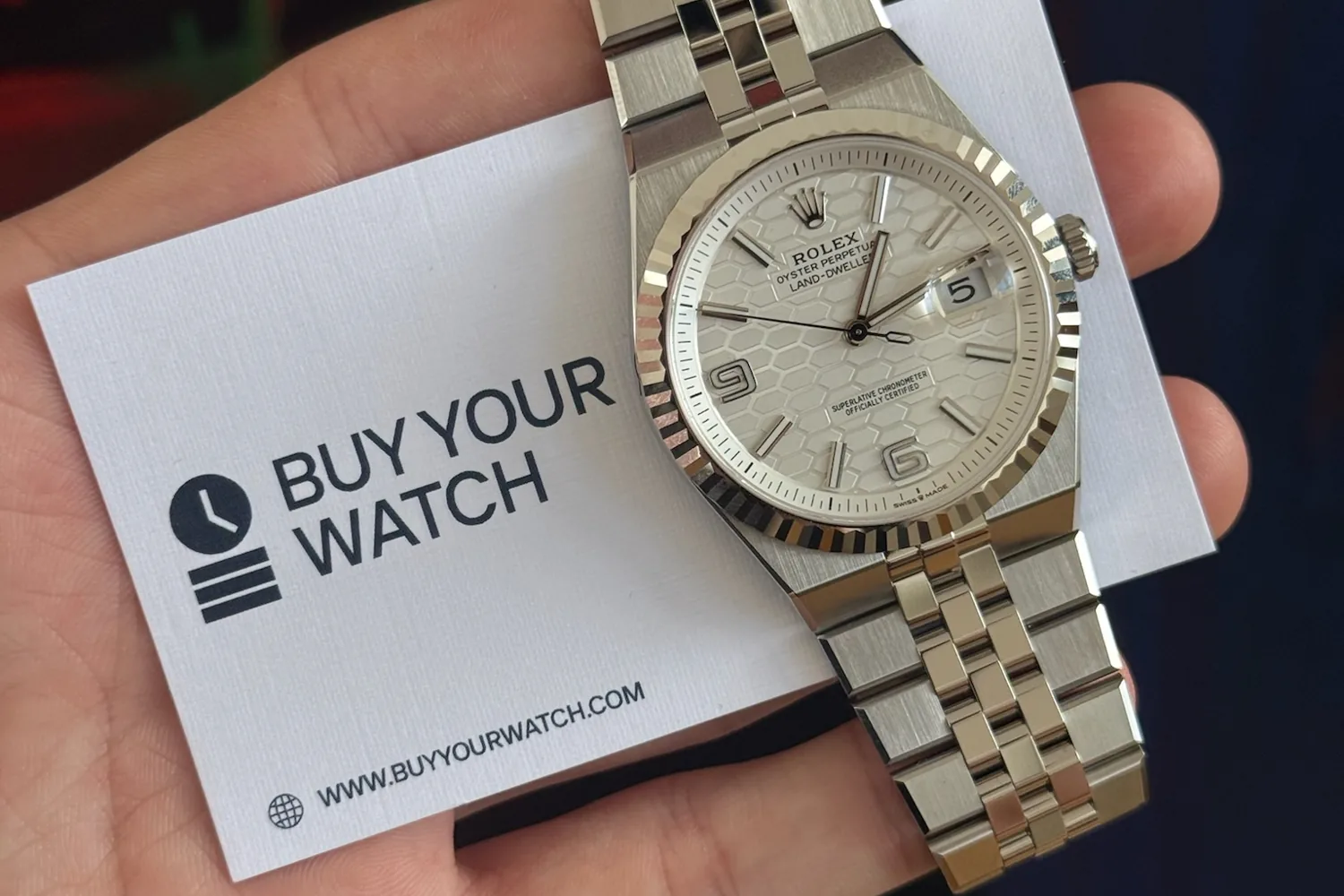
The short answer: "Datejust" on its own tells a buyer almost nothing, because it is the widest family Rolex makes: four case sizes, three bezel styles, two bracelets, steel, two-tone and solid gold, and more dial variants than any other model. Before you accept an offer, identify the exact reference and its size and metal, establish what you hold, check whether every diamond and every part is factory-original, and verify the buyer's licence. On a Datejust more than any other Rolex, the reference and the metal decide whether the watch reaches a buyer's minimum at all, and Buy Your Watch's is $20,000.
Summary
The Datejust is the Rolex most Australians own and the one most often offered for sale, and the offers it draws vary more widely than for any other model because the family spans everything from a steel 31 mm on an Oyster bracelet to a solid gold 41 mm with a factory diamond dial. This guide is organised the way a buyer assesses one: reference and generation first, then metal, bezel, bracelet and dial, then documents, then the two things that trip Datejust sellers specifically, aftermarket modifications and the minimum purchase threshold. It is written by a business that buys Datejusts, which is an obvious interest, disclosed here. Every claim is checkable against the sources at the end regardless of who you sell to.
Key takeaways
- The reference number, engraved between the lugs at 12 o'clock, encodes the size, the metal and the bezel. Read it before you describe the watch to anyone.
- Rolex reworked the Datejust in stages a buyer prices by: sapphire crystal and calibre 3135 from 1988, solid-link bracelets and the six-digit references from the mid 2000s, the 41 mm Datejust II from 2009, the slimmer Datejust 41 and calibre 3235 from 2016, and the 36 mm on calibre 3235 from 2018.
- Metal and bezel move the offer more than condition. A fluted gold bezel and a two-tone or gold case are worth more than the same dial in plain steel, and a factory diamond dial or bezel is worth more again.
- Aftermarket diamonds are a deduction, not a premium. A buyer checks whether every stone was set by Rolex, and a Datejust with a non-factory bezel or dial is bought as a modified watch.
- As a rule, a steel 36 mm or 31 mm Datejust on its own does not reach Buy Your Watch's $20,000 minimum; a 41 mm two-tone or gold Datejust with its card, a solid gold Datejust, or one with factory diamonds often does. If yours is close, ask, and you will be told plainly.
- A licensed dealer must ask for your identification and record the serial. That is the Second-Hand Dealers and Pawnbrokers Act 1989 (Vic), not distrust.
Who this guide is for
An Australian who owns a Rolex Datejust of any size, is considering selling it, and wants to know what a buyer will look at and why the offers on Datejusts range so widely. It assumes you have the watch in hand. It does not give prices, because a price for a Datejust quoted without the reference, the metal and an inspection is a guess.
How this guide was prepared
Reference families, production years and calibres were checked against two independent reference histories and Rolex's own product pages on 15 September 2026. Where sources give different years for a handover, this guide says "about". The legal position is Victorian, because Buy Your Watch holds its licence in Victoria, and each statutory claim names its section. Nothing here is legal, financial or tax advice. Buy Your Watch buys Datejusts, and that interest is stated rather than hidden.
The Rolex Datejust at a glance
The table groups the references a buyer in Australia most often sees by generation. Within each generation the last digits of the reference change with metal and bezel: for the six-digit 36 mm, 116200 is steel with a smooth bezel, 116234 steel with a white gold fluted bezel, 116233 yellow Rolesor with a fluted bezel, and so on. The same pattern carries into the 126 series and the 41 mm. [1] [2]
| Family | Typical references | Years | Case | Calibre | What sets it apart |
|---|---|---|---|---|---|
| Datejust, five-digit, earlier | 16013, 16014, 16018 | about 1977 to 1988 | 36 mm | 3035 | Acrylic crystal, quickset date. Often on a hollow-link Jubilee that has stretched with age. |
| Datejust, five-digit | 16200, 16220, 16233, 16234, 16238 | about 1988 to the mid 2000s | 36 mm | 3135 | Sapphire crystal and calibre 3135 arrive. Tritium lume on earlier dials, Luminova and Super-LumiNova later. |
| Datejust, six-digit | 116200, 116233, 116234, 116238 | about 2005 to 2018 | 36 mm | 3135 | Solid-link bracelets with polished centre links, the improved Oysterclasp, rehaut engraving from about 2007. |
| Datejust 36, current | 126200, 126231, 126233, 126234 | 2018 onward | 36 mm | 3235 | 70-hour power reserve, Chronergy escapement. Same case size as before, new movement. |
| Datejust II | 116300, 116333, 116334 | 2009 to 2016 | 41 mm | 3136 | The first 41 mm Datejust, with a heavier case and broader lugs than the model that replaced it. [4] |
| Datejust 41 | 126300, 126331, 126333, 126334 | 2016 onward | 41 mm | 3235 | Slimmer than the Datejust II, calibre 3235, and the reference most often offered to us today. |
| Datejust 31 | 178240, 178274, 178273 then 278240, 278271, 278273, 278274 | 178 series to about 2020, 278 series onward | 31 mm | 2235 then 2236 | The 278 series brought calibre 2236 with the Syloxi silicon hairspring. [5] |
| Lady-Datejust 28 | 279160, 279171, 279173, 279174 and others | 2017 onward | 28 mm | 2236 | Replaced the 26 mm Lady-Datejust. Many factory diamond dial and bezel variants. |
Every Datejust is rated to 100 metres of water resistance and carries the date under a Cyclops lens. Calibres 3035 and 3135 carry about 48 hours of power reserve; 3235 carries about 70. Rolex certifies its current movements to its Superlative Chronometer standard of minus 2 to plus 2 seconds a day after casing. [3]
Identify the exact reference, size and metal before you ask for a price
The reference is engraved between the lugs at 12 o'clock and, on watches from about 2007, the serial is on the rehaut at 6 o'clock; older watches carry the serial between the lugs at 6. Our guide to Rolex serial and reference numbers shows where each sits and what the serial says about the year.
On a Datejust the reference does three jobs at once. The first digits give the generation and size: 16 and 116 for the 36 mm, 126 for the current 36 mm and the 41, 178 and 278 for the 31, 279 for the 28. The last digits give the metal and bezel: a 0 ending is usually steel with a smooth bezel, a 4 ending steel with a white gold fluted bezel, a 3 ending yellow Rolesor, a 1 ending Everose Rolesor, an 8 ending solid yellow gold. That is why "a two-tone Datejust with a fluted bezel" is not enough: 16233, 116233, 126233 and 126333 all fit that description across four generations and two sizes, and they do not draw the same offer.
Understand why metal, bezel and bracelet move a Datejust offer more than condition
On a Submariner the condition and the documents do most of the work; on a Datejust the configuration does. Three choices made at the factory set the range an offer will fall in before anyone looks at a scratch.
The metal
Steel, yellow Rolesor (steel with yellow gold), Everose Rolesor, white Rolesor (steel with a white gold bezel only), and solid yellow, white or Everose gold. The order of value runs roughly in that order too, and a solid gold Datejust sits in a different bracket from a steel one of the same generation. Check the case back and the bracelet end links as well as the bezel: a two-tone Datejust has gold centre links, and a steel Datejust with a gold-coloured bezel is either white Rolesor with a white gold fluted bezel or has had an aftermarket part fitted.
The bezel
Smooth (Rolex calls the 31 mm version domed), fluted, or diamond-set. The fluted bezel is always precious metal, which is why a 116234 outranks a 116200 in the same steel. A diamond bezel is worth more again, but only if it left Rolex that way; the section on aftermarket parts below explains how a buyer tells. [6]
The bracelet
The five-link Jubilee was made for the Datejust in 1945 and the three-link Oyster came later; both are original fitments and neither is a fault. What a buyer checks is the generation: hollow centre links on older bracelets stretch and sag, solid links on six-digit and later bracelets do not, and a bracelet that has been swapped for one from a different reference is a deduction. Count the links and check the clasp code. [7]
The dial
The Datejust has more factory dial variants than any other Rolex: silver, champagne, black, blue, slate, olive, mother-of-pearl, the slate and green Roman "Wimbledon", the palm and fluted motifs, Roman and Arabic and stick markers, and factory diamond markers at some or all hours. [8] Sought-after factory dials lift the offer; a dial that has been swapped, refinished or set with stones after the fact lowers it, even where the stones are real diamonds.
Check for aftermarket modifications the way a buyer will
The Datejust is the most-modified Rolex in circulation, because its plain steel versions are the most accessible way into the brand and the easiest to dress up. Aftermarket diamond bezels, diamond dials, coloured dials and gold plating are all common in Australia, and a buyer prices a modified Datejust as a modified watch, sometimes below what the plain original would have brought. If you know a part is not original, say so; it is discovered on inspection regardless, and an undisclosed modification is the fastest way to have an offer withdrawn.
- Diamond bezels. Rolex sets stones in a precious-metal bezel and the reference reflects it. An aftermarket bezel is usually set into a base that was originally smooth or fluted, and the case may show tool marks where it was fitted. A buyer compares the reference against the bezel type: a 116200 with a diamond bezel did not leave Rolex that way.
- Diamond dials. Factory stones sit in claw settings on a dial printed for them; aftermarket stones are often glued or set into a standard dial with the hour markers removed. Under magnification the difference is plain, and a buyer will look.
- Refinished or swapped dials. Text that is slightly off-register, a dial colour that was never offered on that reference, or a dial from a different generation are all read as replaced.
- Aftermarket bracelets and clasps. The clasp carries a code and the end links carry a reference; both should match the watch.
None of this stops a modified Datejust selling. It changes what it sells as, and the honest description gets the honest offer.
Establish what you actually have: the watch, the papers, or the full set
The same five items matter as for any Rolex, and on a Datejust the card carries extra weight because it settles the configuration question: it records the reference, and the reference records the metal and bezel the watch left Rolex with. Lay out what you hold and describe it exactly.
- The warranty card or guarantee certificate. Paper certificate to the end of 2006, plastic card from 2007, five-year guarantee from 1 July 2015, and a card with a chip from mid 2020. [9] [10] A card whose reference and serial match the watch is the single most valuable document.
- The box. Nice to have, least weighted.
- Spare links. Especially on a Jubilee, where sizing removes several.
- Service records. More relevant on a five-digit Datejust approaching a service interval than on a 2021 Datejust 41. Rolex suggests a service roughly every ten years.
- The original receipt. Establishes provenance and is the document to keep if a tax question ever arises.
Most Datejusts offered to us arrive as the watch alone, and that is a normal sale. Describe a watch-only Datejust as watch only, and the offer you are given will be the offer you are paid.
Check the watch the way a buyer will
- Wind and set. The Twinlock crown should unscrew, wind smoothly and screw down cleanly. Set the time, advance the date and confirm it jumps at midnight on a quickset movement.
- Read the rehaut and the engraving. Serial on the rehaut from about 2007 and matching the card; reference between the lugs at 12.
- Inspect the bezel. A fluted bezel should have crisp, even flutes; a smooth bezel should be free of deep nicks; a diamond bezel should have every stone present and the setting original.
- Look at the lugs. Sharp edges between brushed tops and polished sides mean an unpolished case. Rounded lugs and thin crown guards mean repeated polishing, which buyers price in.
- Test the bracelet. Hold it by the clasp and let the watch hang: a Jubilee that sags has stretched. Check the clasp closes positively and the end links sit flush against the case.
- Examine the dial under a loupe. Markers, print and any stones as described above. Lume plots aged evenly are fine; one plot a different colour suggests a replaced marker.
- Photograph everything in daylight: dial straight on, case sides, lugs from above, clasp open and closed, rehaut, case engraving, and every document. Send the card serial to your chosen buyer only.
Our guide to how to tell if a Rolex is real covers the authentication checks in depth, and our condition grading guide explains what the grades a buyer uses actually mean.
Know where the $20,000 minimum falls for a Datejust
Buy Your Watch buys watches valued at $20,000 and above, and the Datejust is the model where that line most often needs explaining, because the family straddles it. Without quoting prices, which depend on the watch in front of the assessor, the pattern is this. A steel 36 mm or 31 mm Datejust with a smooth bezel on its own generally does not reach the minimum, and neither does most of the five-digit steel range. A Datejust 41 in two-tone or with a white gold fluted bezel, with its card, is often close to or above it. A two-tone or solid gold 36 mm with its card, a solid gold Datejust of any recent generation, and any Datejust with a factory diamond dial or bezel usually clears it. Precious-metal Lady-Datejusts with factory diamonds can as well.
If yours is anywhere near the line, send the reference, the metal and photographs of the watch and its documents. You will be told plainly, within 24 to 48 hours, whether it is a watch we can make an offer on, and if it is not, the guides to where to sell a Rolex in Australia and who buys watches in Australia set out the routes that suit a watch below it.
Verify the buyer, not just the offer
- Licence number, looked up. Second-hand dealing is licensed state by state; in Victoria under the Second-Hand Dealers and Pawnbrokers Act 1989. Buy Your Watch's number is SHD-0017882, issued by Consumer Affairs Victoria. [11]
- ABN on ABN Lookup, matching the licence name and the paying account.
- Who authenticates. Buy Your Watch uses certified watchmakers in every Australian capital city; they are partner businesses, not our premises.
- A written offer, conditional on authentication, with a timeframe.
- Reviews with the dates showing.
Want a written offer on your Datejust? Send the reference, the metal, a few photographs and what documents you hold. We reply with a written figure conditional on authentication, or tell you plainly if the watch sits below our minimum, and the whole process takes 24 to 48 hours from submission to payment.
Know what a licensed dealer must ask for, and what payment should look like
Section 19 of the Act requires a licensed dealer to ask for evidence of your identity and to refuse the goods if it is not produced; section 20 and the record-keeping regulations require the dealer to record the serial and your details. [11] [12] A buyer who does not ask is the one to be wary of. Payment from a licensed dealer is a bank transfer to an account in your name after authentication. Once authenticated by our certified watchmakers, payment is sent by Osko bank transfer, which typically lands in minutes once sent. The entire process takes 24 to 48 hours from submission to payment. Gift cards, cryptocurrency, overseas cheques and couriers bringing cash are not how a licensed Australian dealer pays for a watch, and no legitimate buyer asks you to pay anything up front. Our guide to the paperwork, the law and the tax question covers the Victorian position in full, including why there is no cooling-off period once you have sold, and the capital gains position, which depends on whether you made a gain and on which category the Australian Taxation Office puts the watch in. [13] Keep the original receipt for at least five years after the sale, and use a registered tax agent for advice you can rely on.
Common mistakes that cost Datejust sellers money
- Describing the watch by size and colour instead of reference. "Two-tone Datejust" covers four generations. Read the engraving.
- Not disclosing an aftermarket part. It is found on inspection and the offer is withdrawn or cut. Say it up front.
- Adding diamonds before selling. Aftermarket stones lower the offer on a Datejust; they do not raise it.
- Polishing the case. It removes metal and softens the lugs. Clean it with a soft cloth and warm water only.
- Swapping the bracelet to "match". A bracelet from a different reference is a deduction, even a Rolex one.
- Sending the serial to every enquiry. Send it to the buyer you have chosen.
- Accepting a verbal offer or an offer with no timeframe attached.
If you would rather keep the watch
A Datejust that clears the threshold can be borrowed against instead of sold. Buy Your Watch offers pawn loans under the same Victorian licence, with a minimum advance of $15,000 over terms of 3 to 12 months, a $400 setup fee, interest of 4% to 10% per month depending on assessment, and a maximum annual percentage rate of 131%. How to pawn a Rolex in Australia walks through the process for a Rolex specifically, and selling your watch or borrowing against it compares the two.
What Buy Your Watch buys, and how it works
Founded in Melbourne in 2023, Buy Your Watch Pty Ltd has purchased more than 1,000 watches, holds second-hand dealer and pawnbroker licence SHD-0017882, and buys from every state. We buy watches valued at $20,000 and above. For a Datejust that means, as a rule, the two-tone, gold and factory-diamond configurations and the better-documented 41 mm references; if you are unsure, ask, and you will get a plain answer within 24 to 48 hours. Payment is by Osko bank transfer once your watch has been authenticated by our certified watchmakers. If yours is a Submariner rather than a Datejust, our Submariner guide covers that model in the same detail.
Pre-sale checklist
- Reference read from between the lugs and matched to the papers; size, metal and bezel confirmed from it
- Serial read from the rehaut or between the lugs and matched to the card
- Every diamond, the bezel, the dial and the bracelet confirmed as factory-original, or the modification noted for disclosure
- Documents laid out and described exactly: card, box, links, service records, receipt
- Card style consistent with the reference and year
- Case not polished; lugs photographed as they are
- Bracelet checked for stretch, clasp code and end links checked, links counted
- Crown, date change and time-keeping tested
- Photographs taken in daylight of every angle and every document
- Buyer's licence number looked up on the state register; ABN checked and matched
- Written offer received, conditional on authentication, with a timeframe
- Payment method confirmed as bank transfer to an account in your name
- Watch sent insured for full value, signature on delivery, serial photographed in the packaging
This is general information, not legal, financial or tax advice. Where it states a legal position it names the statute and section, checked against the primary sources on 15 September 2026. Reference data was checked against the histories listed under sources on the same date.
Frequently Asked Questions
How do I know which Datejust I have?
Read the reference engraved between the lugs at 12 o'clock. The first digits give the generation and size (16 and 116 for the 36 mm, 126 for the current 36 mm and the 41, 178 and 278 for the 31, 279 for the 28) and the last digit gives the metal and bezel: 0 is usually steel with a smooth bezel, 4 steel with a white gold fluted bezel, 3 yellow Rolesor, 1 Everose Rolesor, 8 solid yellow gold. Compare the reference against your warranty card.
Is a two-tone Datejust worth more than a steel one?
As a rule, yes. On a Datejust the metal and the bezel move an offer more than condition does: yellow or Everose Rolesor sits above steel, solid gold above both, and a fluted precious-metal bezel above a smooth steel one. A factory diamond dial or bezel sits higher again. The exact figure depends on the reference, the documents and an inspection.
Do aftermarket diamonds increase the value of a Datejust?
No. Stones set after the watch left Rolex are treated as a modification and a buyer prices a modified Datejust as such, sometimes below what the plain original would have brought. Factory-set diamonds, which the reference reflects, do add value. If you know a part is not original, say so; it is discovered on inspection regardless.
Does Buy Your Watch buy steel Datejusts?
We buy watches valued at $20,000 and above. A steel 36 mm or 31 mm Datejust with a smooth bezel on its own generally sits below that, as does most of the five-digit steel range. A Datejust 41 in two-tone or with a white gold fluted bezel and its card is often close to or above it; two-tone and solid gold Datejusts with their card, and any Datejust with factory diamonds, usually clear it. If yours is near the line, send the reference and photographs and you will get a plain answer within 24 to 48 hours.
What is the difference between a Datejust II and a Datejust 41?
Both are 41 mm. The Datejust II (116300, 116333, 116334) was made from 2009 to 2016 on calibre 3136 and has a heavier case with broader lugs. The Datejust 41 (126300, 126331, 126333, 126334) replaced it in 2016 on calibre 3235, with a slimmer case and a 70-hour power reserve. Buyers price the two differently, so use the reference rather than the size.
Should I polish my Datejust or replace the bracelet before selling it?
No to both. Polishing removes metal and softens the lug edges, which buyers read as a watch that has been through a lot. A bracelet from a different reference, even a genuine Rolex one, is a deduction. Clean the watch with a soft cloth and warm water and sell it as it is.
Does a Datejust without box and papers still sell?
Yes. A watch-only Datejust is a normal sale. The warranty card matters most because it records the reference and therefore the metal and bezel the watch left Rolex with; the box on its own matters least. Describe exactly what you hold and the offer you receive will be the offer you are paid.
How can I tell the year of my Datejust?
Use the serial, the warranty document and the watch itself together. The serial was issued in sequence until about 2010 and randomly after. The guarantee was a paper certificate to the end of 2006, a plastic card from 2007, a five-year guarantee from 1 July 2015 and a chipped card from mid 2020. An acrylic crystal places a Datejust before about 1988; the text at 6 o'clock on the dial moved from tritium markings to SWISS and then SWISS MADE around 1998 to 2000.
Why does a watch buyer ask for my ID?
Because section 19 of the Second-Hand Dealers and Pawnbrokers Act 1989 (Vic) requires a licensed dealer to ask for evidence of identity from anyone selling goods and to refuse the goods if it is not produced, and section 20 requires the dealer to record your details and the serial number. A buyer who does not ask is the one to be wary of.
How is payment made when you sell a Datejust to a dealer?
By bank transfer to an account in your name after the watch has been authenticated. Once authenticated by our certified watchmakers, Buy Your Watch pays by Osko bank transfer, which typically lands in minutes once sent, and the entire process takes 24 to 48 hours from submission to payment. Gift cards, cryptocurrency, overseas cheques and couriers bringing cash are not how a licensed Australian dealer pays.
Sources and references
- All Rolex Datejust references, 1945 to 2026, WristBuzz
- The Evergreens: the history of the Rolex Datejust, Monochrome Watches
- Superlative Chronometer certification: redefining performance, Rolex
- Rolex Datejust 41 vs Datejust II: what is the difference?, Bob's Watches
- Datejust 31, Oystersteel, m278240-0005, Rolex
- Rolex Datejust sizes: a complete guide, Bob's Watches
- Rolex Jubilee vs Oyster bracelet, Bob's Watches
- Rolex Wimbledon dial: a complete buyer's guide, Bob's Watches
- Rolex warranty cards information, Bob's Watches
- Rolex extends international warranty to five years from July 2015, SJX Watches
- Second-Hand Dealers and Pawnbrokers Act 1989 (Vic), s 19: identifying persons selling or pawning goods, AustLII
- Keeping records: second-hand dealer and pawnbroker obligations, Consumer Affairs Victoria
- List of CGT assets and exemptions, Australian Taxation Office