
Authentication
How to Tell if a Rolex Is Real: What Actually Works in 2026
The sweep, weight and cyclops tests are all reproduced by current counterfeits. What still works in 2026, which common checks wrongly fail genuine watches, what Rolex will and will not do for an owner, and what your rights are in Australia if you have bought a fake.
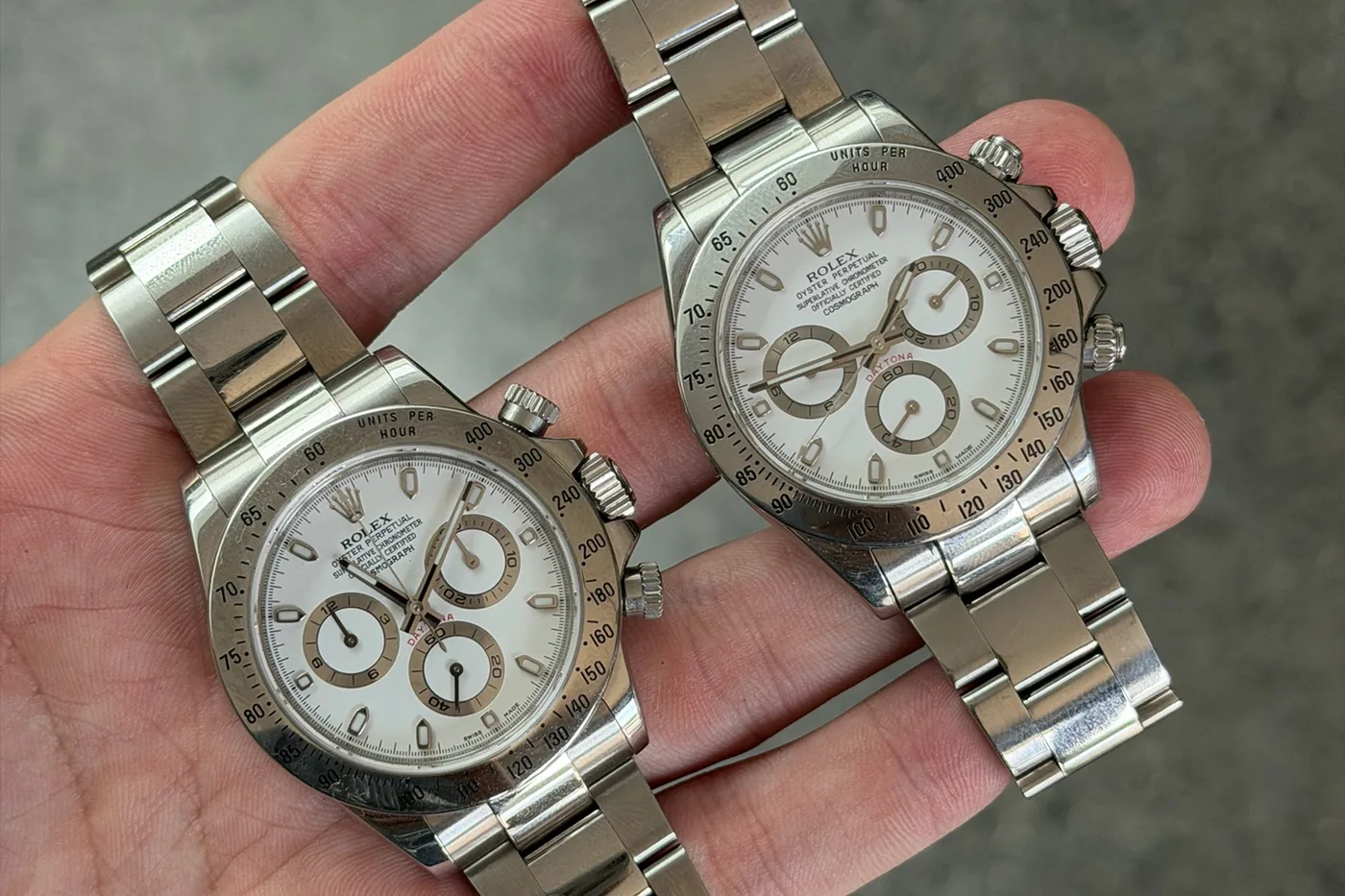
The short answer: you usually cannot tell from the outside. The three tests every guide still leads with, the sweeping seconds hand, the weight and the cyclops, are all reproduced by current counterfeits. What still works is checking internal consistency, timing the watch over several days, and having the case opened to identify the movement.
We authenticate watches for free and we also buy them, so we have an obvious commercial interest in you sending us yours. Everything below is what you can check yourself, including the points where the honest answer is that nobody can tell without opening the case.
Which Rolex authenticity tests still work in 2026?
Most advice online was written for a generation of counterfeit that no longer represents the problem. Here is every common test, graded against what current fakes reproduce.
| Test | What most guides say | Status in 2026 | What it actually proves |
|---|---|---|---|
| Sweeping seconds hand | A real one sweeps, a fake ticks | Obsolete | Only that it is not a cheap quartz fake. Clone movements running at 28,800 vph are sold as a feature. |
| Weight in the hand | A real one feels heavier | Obsolete | Only that it is not hollow. |
| Cyclops magnification | The date must magnify exactly 2.5x | Obsolete | Nothing. Replica sellers list a 2.5x cyclops as a product feature. |
| Laser-etched coronet at 6 o'clock | If it is there, it is real | Weak, and inverted | Judge difficulty, not presence. A genuine one is near invisible without a loupe, and watches made before the early 2000s have none at all. |
| Rehaut engraving with serial at 6 | Absence means fake | Weak, and inverted | Absence is correct on anything predating the rollout for that model. Presence on a watch whose serial clearly predates 2004 is the real red flag. |
| Serial number dating | Look up the year to confirm it | Broken since 2010 | Nothing alone. Rolex randomised serials in 2010 and publishes no lookup an owner can query. |
| Solid screw-down caseback | A display back means fake | Useful, with real exceptions | Genuine display backs exist on current references. See below. |
| Green hologram caseback sticker | Real Rolexes have one | Obsolete | Nothing. It is not applied to current watches, and Millenary Watches warns that its presence is not proof of authenticity. |
| Crown marking against case metal | Rarely mentioned at all | Useful, and under-used | The marks under the coronet denote the crown's sealing system and the case metal. A mismatch is worth investigating. |
| Internal consistency of reference, serial, rehaut, crown, metal and era | Almost never mentioned | The strongest external test | A great deal. Fakes are built to a model, not to one serial's correct specification. |
| Timing over several days | Almost never mentioned | Useful, and free | In our experience a clone movement holds approximate time but drifts noticeably over a week. A prompt to look harder, not a verdict. |
| Identifying the calibre with the case open | Not possible for the owner | The definitive test outside Rolex | Nearly everything. |
Why is "a real Rolex sweeps, a fake ticks" wrong?
It is wrong in both directions. A modern Rolex automatic beats at 28,800 vibrations per hour, so the seconds hand steps eight times a second rather than gliding: true of calibre 3135, of calibre 3235, and of calibre 4131, which replaced calibre 4130 in the Daytona in 2023. Under a loupe you can count the steps, and anyone waiting for perfectly smooth motion will eventually reject a genuine watch. Rolex adopted that rate in 1977 with calibre 3035, so a 1960s watch running calibre 1560 at 18,000 vph steps five times a second and is correctly steppier. And the quartz Oysterquartz, made from the mid-1970s into the early 2000s, ticks once a second and is entirely genuine.
The clearest evidence comes from the counterfeiters. Clone movements running at 28,800 vph are now sold as a selling point, alongside correct font spacing, a 2.5x cyclops, laser-etched crown logos and aligned rehaut engravings. When the people making the fakes treat your test as a product feature, the test is finished.
Do weight, the cyclops and the hologram sticker prove anything?
- Weight. Rolex has used 904L stainless steel since 1985, and better fakes use steel of a similar density and are weighted to match. A hollow feel still tells you something. A correct weight tells you nothing.
- The cyclops. Current fakes reproduce the magnification, and not every dated Rolex has a cyclops at all: the Sea-Dweller went without one until reference 126600 in 2017.
- The hologram sticker. It is not applied to current watches, so its absence on a modern Rolex is normal, and its presence proves nothing. Millenary Watches puts it plainly: the idea that a green caseback sticker means a watch is authentic is a misconception.
Does a missing rehaut engraving or laser-etched crown mean a Rolex is fake?
No, and this is where consumer guides do real harm, because they teach people to reject genuine vintage watches. The laser-etched coronet at 6 o'clock is etched into the sapphire at microscopic scale, which is why it needs a loupe and raking light to find at all. Millenary Watches dates the start of crystal etching to 2001 and says it was not across the line until about 2003, so anything older correctly has none, and a Rolex service crystal may carry no coronet at all. The exact model-by-model dates are disputed, which makes absence on an early 2000s watch inconclusive rather than damning.
The engraved rehaut, the inner ring reading ROLEXROLEXROLEX with the serial at 6, began in 2004 and was introduced model by model from there. Any reference discontinued before the rollout reached it never carried one at all. Absence on an older watch is expected. The red flag is the reverse: a crisp rehaut engraving on a watch whose serial clearly belongs to 2003. Even the guides that lead with these marks treat them as one data point among several rather than a verdict.
What does a Rolex serial number actually tell you?
Less than you would hope. Rolex randomised serials in 2010, so a modern serial cannot be decoded to a year, which is why the published serial-to-year tables run out at the end of the sequential era, and Rolex publishes no lookup an owner can query. What a serial does is place a watch in an era, so you can ask the only question that matters: does the rest of the watch agree with it? These are the date lines that decide which checks apply, as at August 2026.
| Feature | Applies from | Notes |
|---|---|---|
| 28,800 vph movement | 1977, calibre 3035 | Earlier: 18,000 vph (calibre 1560), 19,800 vph (calibre 1570) |
| Laser-etched coronet on the crystal | From 2001, across the line by about 2003 | Millenary Watches. Model-by-model dates are disputed, so absence on an early 2000s watch is inconclusive rather than damning |
| Engraved rehaut, ROLEXROLEXROLEX | From 2004, model by model | Absent from any reference discontinued before the rollout reached it |
| Serial engraved between the lugs | Until around 2008 | Visible only with the bracelet removed. Overlaps with the rehaut serial from about 2005 |
| Serial on the rehaut | From about 2005, rehaut only from 2008 | Millenary Watches puts the point at which every model carried it at 2010 |
| Randomised serial numbers | Middle of 2010 | A serial no longer decodes to a production year |
| Green hologram caseback sticker | Not applied to current watches | Correctly absent on a modern Rolex |
| Sea-Dweller with a cyclops | 2017, reference 126600 | No cyclops before that is correct, not suspicious |
| RLX titanium cased models | 2022, Deepsea Challenge 126067 | Grade 5 titanium. Absent from every older authentication guide |
| Rolex Cotes de Geneve on the bridges | 2023, calibres 4131 and 7140 | Seen through the display backs of the platinum Daytona and the Perpetual 1908 |
Which Rolex rules have gone out of date since 2023?
- "Rolex never uses Cotes de Geneve." False since 2023. The bridges of calibre 7140, the movement Rolex built for the Perpetual 1908, carry a Rolex Cotes de Geneve finish, described as differing from the traditional decoration by a slight polished groove between each band. Calibre 4131, introduced the same year, carries Rolex's own striping too.
- "A display caseback means it is fake." Mostly right, and wrong on two current references. The Perpetual 1908 has an exhibition caseback, and calibre 4131 brought one to the platinum Daytona, where calibre 4130 had always sat behind a solid back.
- "Every Rolex has a screw-down crown and an Oyster case." Not the Perpetual 1908, which has no Oyster case architecture and a sapphire display back. It breaks two rules at once and is genuine.
- "A Sea-Dweller with a cyclops is fake." True for decades, false since 2017, when reference 126600 arrived with one.
What actually works, in order?
Our own ordering, not a published standard.
- Open the case and identify the calibre against the reference. Not a job for the owner, but the only check that settles the question.
- Time it over several days. Wear it for a week against your phone. It costs nothing. Two cautions before you draw a conclusion: vintage references were built to looser standards than current ones, and any watch overdue a service will run badly whether or not it is genuine. Poor timekeeping is a reason to look harder, never a verdict on its own.
- Check internal consistency: reference against serial, serial location against era, rehaut against era, crown marking against case metal, calibre against reference.
- Check the crown marking against the case metal. Rolex marks the crown under the coronet to denote the sealing system, Twinlock or Triplock, and the case metal. Rolex does not publish a decode table and the ones circulating in the trade disagree in places, so use this as a consistency check alongside a watchmaker rather than as a verdict of your own.
- Treat the laser-etched coronet as corroboration only, judged on how hard it is to see.
- Check the bracelet, clasp and end-link fit. Bracelets are expensive to fake well, and are often where an otherwise convincing watch gives itself away.
- Follow the provenance. Who sold it, when, and whether there is a trail.
What cannot be determined without opening the case?
This is the part the American guides leave out. Five things cannot be established from outside, however good the photographs.
- Whether the movement is a genuine Rolex calibre or a clone, since clones now copy rotor engraving and bridge decoration.
- Whether the calibre is correct for that reference and serial range.
- Whether the movement's own engravings and serial are unaltered.
- Whether a genuine case houses a genuine but wrong movement.
- Whether internal parts have been swapped for aftermarket ones.
Independent watchmakers say the same thing: some current fakes can only be settled by removing the caseback. Do not attempt it yourself. It needs a model-specific tool, some casebacks are built to resist anything else, and the watch must be resealed and pressure-tested afterwards. That is why authentication by a certified watchmaker is a physical process, not a photo review.
Will Rolex authenticate a watch for you?
Rolex publishes no authentication service for the public. Its published guidance for owners goes no further than telling you to buy from an Official Rolex Retailer, which is the line the retailers themselves repeat: Watches of Switzerland states that Rolex watches, new or pre-owned, should only be bought from Official Rolex Retailers. Confirmation of authenticity is reserved to Rolex's own workshops and is not offered as something a member of the public can request. Rolex does issue one authenticity document, the Rolex Certified Pre-Owned certificate. The constraint is who it applies to: Certified Pre-Owned watches are sold by Official Rolex Retailers out of their own stock, certified, serviced, guaranteed and carrying a Rolex seal, so it is not a programme an owner can submit a watch to. A service is not an authentication either. It is a repair and overhaul, and Rolex does not offer or publish it as an authenticity check.
Rolex maintains an Australian service operation and a network of Official Rolex Retailers, but what an individual boutique will do informally is not published, so ring and ask. The limit on our side is worth stating too: an independent watchmaker cannot issue a Rolex certificate, because Rolex does not authorise anyone outside its own network to do so. What a certified watchmaker produces is a professional opinion and a written report, and that is what the second-hand market actually transacts on.
What does watch authentication cost in Australia?
What authentication costs in Australia, as at August 2026. Prices move, so check the provider's own page before you rely on any figure here.
| Provider | Service | Price | Written report |
|---|---|---|---|
| Buy Your Watch, Australia-wide, certified watchmakers in every major city | Certified watchmaker authentication, no obligation to sell | Free | Yes, with condition report and market valuation, typically 24 hours from submission |
| Independent Australian watchmakers | Verbal authentication, or a written letter or certificate | Paid, quoted per watch | Varies. Ask whether the quoted fee includes opening the case, resealing it and pressure testing it. |
| Rolex Australia | No authentication service published for the public | Not applicable | No. Certified Pre-Owned covers only watches an Official Rolex Retailer already holds. |
One distinction catches people out: a free valuation is not an authentication. Several Australian buyers offer free valuations without opening the watch. A valuation tells you what a watch is worth if it is what it appears to be. Authentication establishes the "if". We cover the two largest markets directly, with watch authentication in Sydney and Melbourne.
Is a Rolex without box and papers fake?
No, and this belief costs honest sellers money every week. Rolex does not re-issue a guarantee card and does not change the original purchaser's name on one, so a Rolex whose papers were lost twenty years ago is permanently a watch without papers: normal, and not fixable. It affects price and speed of sale, covered in how much a Rolex is worth in Australia and in our complete guide to selling a Rolex, but it says nothing about authenticity.
What is a franken Rolex, and why does it matter more than a fake?
A franken is a watch assembled from parts of different watches or periods, usually to present as something it is not. Every part can be genuine Rolex and the watch still be neither original nor honestly described. The Australian exposure here is consumer law rather than trade mark law: the ACCC states that any description of a product by a business must be accurate, whether written or spoken, so describing a modified watch as an original one is a misrepresentation whether or not the parts themselves are genuine. That is general information rather than legal advice. The practical lesson is that aftermarket diamonds, replacement dials and heavy polishing all reduce what a specialist will pay, sometimes severely, as our guide to watch condition grading covers.
What are your rights in Australia if you buy a fake Rolex?
Bought from a business, Australian Consumer Law guarantees apply. The ACCC states that any description of a product by a business must be accurate, whether written or spoken, and that the basic rights covered by consumer guarantees cannot be taken away by anything a business says or does, including a no-refunds sign. The ACCC also treats a product that is very different from its description as a major problem, and where the problem is major it says the business must give the consumer the choice of a refund or a replacement, with the alternative of keeping the product and being compensated for the drop in value. A watch sold by an Australian business as a genuine Rolex that turns out not to be one sits squarely inside that.
Bought privately, most of that disappears. The ACCC says most consumer guarantees do not apply to one-off sales between two people where the seller is not running a business, and that only three always apply: title to the product, undisturbed possession, and no hidden debts or charges. A Rolex bought from a private seller on a marketplace therefore carries no statutory guarantee that it must match its description, and your recourse is a misrepresentation or fraud claim instead. That is why the checks in how to vet a watch buyer matter more here than in most countries, and why it is worth comparing routes in where to sell a watch in Australia before you buy or sell one privately. This is general information rather than legal advice.
Importing carries its own risk. Part 13 of the Trade Marks Act 1995 (Cth) deals with the importation of goods infringing Australian trade marks, and section 133 empowers the Comptroller-General of Customs to seize goods that infringe a registered trade mark. A counterfeit bought overseas can be stopped on arrival, which means losing the watch on top of what you paid for it.
How our free authentication works, and why we offer it
The incentive should be stated. Buy Your Watch buys watches, so a business offering free authentication is hoping a proportion of what it sees is eventually sold to it. Read every free offer in this category, ours included, with that in mind. What we do about it is remove the obligation. Authentication is free, carried out in person by certified watchmakers, with no obligation to sell afterwards. You get the findings either way, including the condition report and a market valuation, typically within 24 hours of submission. If the watch is genuine and you want to keep it, you owe us nothing. If you want to sell, we buy outright and pay by Osko or PayID once authentication is complete. If you would rather borrow than sell, we also lend against watches as a licensed pawnbroker: a minimum advance of $10,000 over terms of 3 to 12 months, a $400 setup fee covering authentication and insured storage, interest of 5% to 10% per month depending on the assessment, and a maximum APR of 142%. The full terms are on the terms and conditions page.
Buy Your Watch has purchased more than 1,000 watches and is a licensed second-hand dealer and pawnbroker, licence number SHD-0017882, ABN 85 670 502 315. Send photos through the valuation form to start, or read our page on selling a Rolex. And if the watch is not genuine, we will tell you so plainly and in writing, at no cost. That is the least useful outcome for us and the most useful one for you.
Frequently Asked Questions
How can I tell if my Rolex is real?
You usually cannot tell for certain from the outside, because current counterfeits reproduce the sweeping seconds hand, the weight, the cyclops magnification, the laser-etched crown and the rehaut engraving. What still works is checking internal consistency between reference, serial, rehaut, crown marking, case metal and production era, timing the watch over several days, and having a certified watchmaker open the case to identify the calibre. Nothing settles the question from a photograph, because the movement is where the answer is.
Does a real Rolex tick or sweep?
Both, depending on the watch, which is why the test is useless. A modern Rolex automatic beats at 28,800 vibrations per hour, so its seconds hand advances in eight small steps every second rather than gliding, and a genuine quartz Rolex Oysterquartz, made from the mid-1970s into the early 2000s, ticks once a second. Clone movements running at 28,800 vph are now sold openly to reproduce the sweep, so passing this test tells you only that the watch is not a cheap quartz fake.
Can Rolex tell me if my watch is genuine?
Rolex publishes no authentication service for the public, so in practice no. Its published guidance for owners goes no further than telling you to buy from an Official Rolex Retailer, and its Certified Pre-Owned programme certifies watches an Official Rolex Retailer already holds in its own stock rather than watches an owner submits. A Rolex service is not an authentication either: it is a repair and overhaul, and Rolex does not offer or publish it as an authenticity check.
How much does it cost to authenticate a Rolex in Australia?
Independent Australian watchmakers charge for authentication, and the fee varies by provider and by whether you want a verbal opinion or a written report. Ask whether the quoted price includes opening the case, resealing it and pressure testing it, because that is the step that actually settles the question. Buy Your Watch authenticates free of charge, by certified watchmakers, with no obligation to sell afterwards.
Is my Rolex fake if it has no box and papers?
No. Rolex does not re-issue a guarantee card and does not change the original purchaser's name on one, so a second-hand Rolex whose papers were lost years ago is permanently a watch without papers. That is completely normal on the pre-owned market. Missing papers affects the price and the speed of a sale, but it tells you nothing at all about whether the watch is genuine.
Can you check a Rolex serial number to see if it is real?
No, and there is no public database to check it against. Rolex randomised its serial numbers in 2010, so a modern serial cannot be decoded to a production year, and the published serial-to-year tables run out at the end of the sequential era for that reason. What a serial is useful for is placing the watch in an era, so you can check whether the rehaut, crown marking, crystal etching and calibre all agree with that era.
Does a missing rehaut engraving mean my Rolex is fake?
No. The engraved rehaut began in 2004 and was introduced model by model from there, so any reference discontinued before the rollout reached it never carried one at all, and its absence on an older watch is expected and correct. The real red flag is the opposite: a crisp rehaut engraving on a watch whose reference and serial clearly predate the rollout. Rejecting a genuine vintage watch on this point is a mistake we see regularly.
What should I do if I bought a fake Rolex in Australia?
It depends entirely on who sold it to you. If you bought from a business, Australian Consumer Law guarantees apply, and the ACCC states that any description of a product by a business must be accurate, whether written or spoken. The ACCC treats a product that is very different from its description as a major problem, and says the business must then give the consumer the choice of a refund or a replacement. If you bought privately from an individual, the ACCC says most consumer guarantees do not apply, and only title, undisturbed possession and freedom from hidden debts or charges always do, so your recourse is a misrepresentation or fraud claim rather than a consumer guarantee. This is general information rather than legal advice.
Related Articles
- AuthenticationRolex Serial and Reference Numbers: Where to Find Them and What They Mean14 min read
- AuthenticationWhat Watch Authentication Costs in Australia: Every Option Compared9 min read
- Selling GuidesHow to Sell a Patek Philippe Nautilus in Australia: What to Check Before You Accept an Offer18 min read