
Authentication
Rolex Serial and Reference Numbers: Where to Find Them and What They Mean
Where the reference and serial numbers sit on a Rolex, what each digit means, and why a matching serial can never prove a watch is genuine. Prefix and metal-code tables with the disagreements between the published charts shown, plus the checks that no longer work.
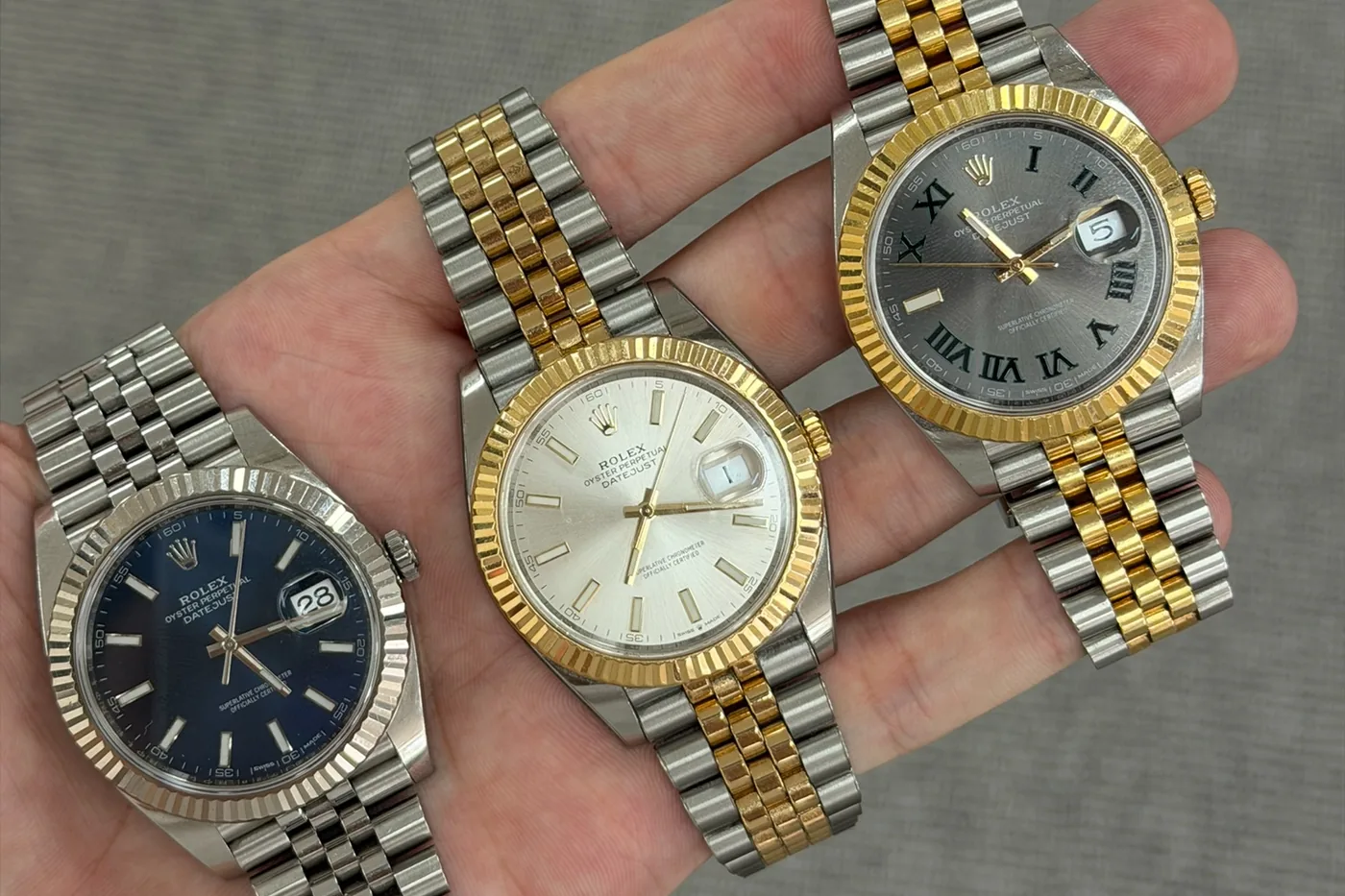
The short answer: your Rolex reference number is engraved between the lugs at 12 o'clock, hidden under the bracelet. The serial number sits between the lugs at 6 o'clock on watches made up to about 2008, and on the rehaut, the ring between the dial and the crystal, on every model from about 2010. Neither number proves a watch is genuine.
That sentence costs us business, so we will deal with it first. We authenticate watches free of charge, and the request we get most often is to run a serial number and confirm a watch is real. We cannot, and nor can any dealer or website: Rolex has never published serial data, and there is no public channel through which an owner can have a number looked up. What the numbers do is tell you what a watch should be, and expose one that contradicts itself.
Where is the serial number on a Rolex?
It depends on when the watch was made, and getting this wrong is the usual reason someone takes the bracelet off a watch that never needed touching.
| Number | Where it is | Position | Bracelet removal needed |
|---|---|---|---|
| Reference (model) number, all eras | Case side, between the lugs | 12 o'clock | Yes, always |
| Serial, up to about 2008 | Case side, between the lugs | 6 o'clock | Yes |
| Serial, the changeover years, roughly the mid-2000s to 2010 | Often both: between the lugs and on the rehaut | 6 o'clock in both places | Check the rehaut first |
| Serial, about 2010 onwards | Rehaut only, the inner flange between dial and crystal | 6 o'clock | No, readable through the crystal |
| Calibre and movement numbers | On the movement itself | Not applicable | Caseback removal, watchmaker only |
So if your Rolex was made from about 2010 onwards, leave the bracelet alone: angle it under a lamp and read the rehaut at 6 o'clock through the crystal. If it was made before the mid-2000s, an absent rehaut engraving is correct, not suspicious. Levering out spring bars is how lugs get scratched.
Why do some Rolex watches have the serial number in two places?
Because the change was gradual. Rolex added the rehaut engraving as an anti-counterfeiting measure. Millenary Watches gives the reason as making life harder for fake manufacturers, "since it is difficult to laser engrave with the same perfection that Rolex has".
The same source dates the changeover in two steps: in 2008 Rolex stopped engraving the serial between the lugs and used only the rehaut, and by 2010 that had become the case for all Rolex models. Its reference-number guide puts the switch at 2010 as well. Through the years when both engravings were being applied, many watches carry the serial in both places, which is why finding it in only one place on a watch from that window is not by itself a red flag. Published accounts disagree about exactly when the first engraved rehauts appeared, which is itself a reason not to date a watch from the rehaut alone.
Some references were discontinued before the rehaut arrived and never had one, notably the Explorer 14270, which ended production in 2001. The GMT-Master II 16710 is the harder case: it ran until about 2007, so most examples have no rehaut engraving and the last of them can.
Can you tell what year a Rolex was made from the serial number?
Up to a point, and only for watches made before roughly mid-2010.
| Era | Format | Dateable from the number? |
|---|---|---|
| About 1926 to the mid-1950s | Sequential digits, growing from five digits to six. Bob's Watches starts 1926 at 00,001 and Millenary Watches at 28,000 | Roughly, to a band of a year or two |
| The mid-1950s | The two charts disagree. Bob's Watches shows 855,726 for 1953 and then 23,000 for 1954, a restart from a low figure. Millenary Watches shows 935,000 for 1954 and 1,010,000 for 1955, running straight past a million | No. Treat a low five-digit number from this period as ambiguous |
| Mid-1950s to 1987 | Sequential, growing to seven digits. Bob's Watches puts 1987 at about 9,400,000 | Roughly, to a band of a year or two |
| 1987 to about mid-2010 | One letter prefix plus six digits, for example R123456 | To a band of one to three years, not a year |
| About mid-2010 to now | Random: eight alphanumeric characters, letters and digits mixed | No. Not by anyone outside Rolex. |
Two things catch people out. First, the mid-1950s. The published charts do not agree on what happened: Bob's Watches shows the numbers restarting from a low figure, 855,726 in 1953 and then 23,000 in 1954, while Millenary Watches shows them running continuously past a million. Follow one chart and a low five-digit serial is a 1950s watch, follow the other and the same number belongs to the 1920s. A serial from that period has to be resolved by the reference, case and movement, not by the chart.
Second, the modern random series. Those serials are eight alphanumeric characters, not eight digits, so a letter mid-string is normal. Millenary Watches puts it directly: from the middle of 2010 Rolex started using random serial numbers, and with watches from that point onwards it is impossible to use the serial number to date the watch. A post-2010 Rolex is dated instead by its warranty card, by the production window of the reference, and by the guarantee itself: Rolex moved to a five-year international guarantee in 2015, so a card carrying the older two-year term places the watch before that change. If what you are really after is a figure rather than a date, our guide to how much a Rolex is worth in Australia is the more useful page.
Which years does each Rolex serial letter prefix cover?
Read this before the table. Rolex has never published serial data, so every chart in circulation, including those on the large American dealer sites, is reconstructed from collector and dealer records. Millenary Watches says as much of its own chart, warning that the numbers "may not be 100% correct since they haven't been released officially by Rolex". The bands below were cross-checked in August 2026 against the two charts we could verify, at Bob's Watches and Millenary Watches, and widened so that each band covers both readings. The two disagree at the very first prefix: R is 1987 on one chart and 1988 on the other. Use these bands to narrow a watch to a period, never to claim a year.
| Prefix | Approximate years | Notes |
|---|---|---|
| R | 1987 to 1988 | First of the letter series. Bob's Watches gives 1987, Millenary Watches 1988 |
| L | 1989 | Both charts agree |
| E | 1990 to 1991 | |
| X | 1991 to 1992 | Runs alongside N in 1991 |
| N | 1991 | Runs alongside X |
| C | 1992 | |
| S | 1993 to 1994 | |
| W | 1995 | Both charts agree |
| T | 1996 | Both charts agree |
| U | 1997 to 1998 | |
| A | 1998 to 2001 | The two charts place A differently across these years |
| P | 2000 to 2001 | Runs alongside K in 2000 |
| K | 2000 to 2002 | Runs alongside P, then Y |
| Y | 2001 to 2004 | Runs alongside K, then F |
| F | 2003 to 2007 | The widest disagreement of any prefix |
| D | 2005 to 2007 | Runs alongside F, then Z |
| Z | 2006 to 2008 | Runs alongside D, then M |
| M | 2006 to 2008 | Runs alongside Z, then V |
| V | 2008 to 2009 | Runs alongside M in 2008 |
| G | 2010 | Last of the letter series |
| Random, eight characters | About mid-2010 onwards. Millenary Watches says the middle of 2010, the Bob's Watches chart shows random serials from 2011 | Cannot be dated |
The bands overlap and the letters are not alphabetical. That is not sloppy charting, it is Rolex running more than one prefix series at a time. The Bob's Watches chart shows N and X both starting in 1991, K and P both in 2000, D and F together in 2005, D or Z in 2006, M or Z in 2007, and M or V in 2008. That is why a serial gives a band rather than a date, and why any source printing one confident year is overstating what it knows.
Is there a Rolex serial number database I can check?
No, and there never has been. As Millenary Watches puts it, "Rolex does not have an official database of all serial numbers which they disclose to the public." Every Rolex serial checker we have used, including those run by the largest American dealers, is querying a crowd-sourced chart, not Rolex.
Rolex keeps its own production records to itself. Millenary Watches adds that "Authorized Rolex retailers do not have access to a Rolex serial database either", so there is no counter anywhere that can look your number up. Unlike Patek Philippe, which issues owners an extract from its archives, Rolex offers nothing of the kind.
What does a Rolex reference number actually mean?
The reference describes the watch rather than counting it. Length tells you the era: four digits generally means pre-late-1970s, five digits from the late 1970s until the 2000s, six digits from about 2000 onwards. The system below applies only to five and six digit references; on four-digit vintage references gold was denoted by a suffix instead, as in the gold GMT-Master 1675/8. On a modern reference, the leading digits give generation and model family, the second-to-last digit is conventionally read as the bezel, the last digit the case metal, and the letters the bezel colour. That last digit is the most reliable part of the whole system.
| Last digit | Case metal | Reference to check it against |
|---|---|---|
| 0 | Oystersteel | 126500LN Daytona |
| 1 | Everose Rolesor, steel and 18ct Everose gold | 126331 Datejust 41 |
| 2 | Rolesium, steel with platinum bezel | 126622 Yacht-Master 40 |
| 3 | Yellow Rolesor, steel and 18ct yellow gold | 126503 Daytona |
| 4 | White Rolesor, steel and 18ct white gold | 126334 Datejust 41 |
| 5 | 18ct Everose gold on current references. Older tables print gold shell, no longer used | 126715CHNR GMT-Master II |
| 6 | 950 platinum | 126506 Daytona |
| 7 | RLX titanium on current references. Older tables print 14ct gold, no longer used | 226627 Yacht-Master 42 and 126067 Deepsea Challenge |
| 8 | 18ct yellow gold | 126718GRNR GMT-Master II |
| 9 | 18ct white gold | 228239 Day-Date 40 |
Digits 7 and 5 are worth pausing on, because the published tables have not kept up. Millenary Watches, checked in August 2026, still lists 7 as 14ct yellow gold, no longer used, and 5 as gold shell, no longer in use. Rolex's current catalogue uses both codes differently: 7 for RLX titanium, as on the Yacht-Master 42 reference 226627 and the Deepsea Challenge 126067, and 5 for solid 18ct Everose gold, as on the GMT-Master II 126715CHNR. Any metal-code table more than about two years old is out of date on those two rows.
The letters after the digits describe the bezel, in abbreviated French.
| Suffix | French | Meaning |
|---|---|---|
| LN | lunette noire | Black bezel |
| LB | lunette bleue | Blue bezel |
| LV | lunette verte | Green bezel |
| BLRO | bleu, rouge | Blue and red, the "Pepsi" |
| BLNR | bleu, noir | Blue and black, the "Batman" |
| CHNR | chocolat, noir | Brown and black, the "Root Beer" |
| GRNR | gris, noir | Grey and black |
| GV | glace verte | Green crystal, as on the Milgauss |
Gem-set bezels carry codes of their own, TBR, TEM, RBR and the SA family among them. The mainstream reference guides either leave them out or disagree about the French behind them, so they are left out here rather than guessed at.
How do you read a Rolex reference number in practice?
Three worked examples, the last of which shows where the system stops working.
- 126610LN, Submariner Date. 12 current generation, 66 the Submariner Date and Sea-Dweller, though the no-date Submariner 124060 does not follow it, 1 the variant digit separating the Submariner Date from the Sea-Dweller 126600, 0 Oystersteel, LN lunette noire, the black Cerachrom bezel. It is 41mm on calibre 3235, and replaced the 40mm 116610LN.
- 126710BLRO, GMT-Master II "Pepsi". 12 current generation, 67 the GMT-Master II family, 1 the variant digit, which is not a reliable bezel code (see the Daytona below), 0 Oystersteel, BLRO bleu and rouge. The steel 126710BLRO was launched at Baselworld 2018 on a Jubilee bracelet, with calibre 3285 and a 70-hour power reserve. Its white gold sibling is 126719BLRO, the 9 marking white gold. The steel GMT-Master II runs 16710, then 116710, then 126710, though the Pepsi bezel skipped the 116710 generation in steel entirely.
- 116500LN, Cosmograph Daytona. 11 the calibre 4130 generation, 65 the Daytona family, 0 the variant digit, 0 Oystersteel, LN the black Cerachrom bezel. It is the 2016 steel Daytona with the black Cerachrom bezel, superseded in 2023 by the 126500LN on calibre 4131.
The Daytona exposes the limit. Millenary Watches lists the second-to-last digit as a bezel code, with 0 for smooth or domed, 1 for engine turned and 6 for rotatable. A Daytona bezel carries a tachymetric scale and a Submariner bezel rotates, yet the Daytona 116500LN has a 0 in that position and the Submariner 126610LN a 1. What the 0 really does on the 116500LN is separate the ceramic-bezel Daytona from the earlier steel-bezel 116520. Rolex never published the system, so treat it as dependable for the metal digit and the letter suffix, and unreliable for the bezel digit.
One more thing that alarms owners needlessly: the catalogue reference on a warranty card carries a four-digit suffix, such as 126610LN-0001, denoting dial and bracelet variations. The engraved case reference omits it. A card and a case showing different-length references is normal.
Which Rolex serial number tests no longer work?
These are the beliefs we correct most often, all still repeated on well-ranked sites.
- "Check it against Rolex's official database." There is no public database and never has been. The tool you are using queries a crowd-sourced chart.
- "The serial is between the lugs at 6 o'clock." True up to about 2008. On a Rolex made from about 2010 it is on the rehaut instead.
- "The serial is on the rehaut." Wrong for Rolex watches made before the mid-2000s, which is a great many of the watches that come to us.
- "Random serials are eight digits." Eight alphanumeric characters, letters included. A letter in the string does not indicate a fake.
- "Random serials started in 2012." Millenary Watches puts it at the middle of 2010, and the Bob's Watches chart shows random serials from 2011. Rolex never announced it.
- "A five-digit serial means a 1920s or 1930s Rolex." Not on its own. The two published charts disagree about the mid-1950s, and one of them puts low five-digit numbers in 1954.
- "The last digit 7 means 14ct gold." It did on vintage references, and the older tables still say so. Rolex uses it for RLX titanium on current ones.
- "Fakes have no serial, or have it in the wrong place." Modern counterfeits carry serials in the correct positions, and engraved rehauts too.
- "The model number sits next to the serial." They are on opposite sides of the case, at 12 and 6 o'clock.
- "Ask Rolex for an extract from the archives." Patek Philippe offers that. Rolex does not.
Can a fake Rolex have a real serial number?
Yes, and this is the most important thing on the page. Counterfeiters harvest genuine serials from online listings, auction photographs and stolen watches, then laser-engrave them onto fake cases and rehauts. The same number also turns up on more than one fake, because a replica run reuses whatever serial it was set up with. A serial can disprove a watch. It can never prove one.
Two checks do work. The first is engraving quality, which is about how the number was cut, not what it says. Genuine Rolex engraving is cut deep with diamond-tipped tooling or high-precision laser, leaving sharp edges that catch light like a cut stone. Counterfeit engraving is typically acid-etched, shallow and sandy or granular, with blurry or misaligned characters. Under magnification the difference is not subtle.
The second is internal consistency. The engraved number has to agree with the model, metal, dial and bracelet in front of you. A D-series serial, nominally 2005 to 2007, on a 41mm 126610LN is impossible however real that serial is, because the reference did not exist yet. That test catches parts watches and redials as well as outright fakes, and it is why our free authentication puts the whole watch in front of a certified watchmaker rather than typing a number into a box.
What can a Rolex serial number actually be checked against?
One thing, usefully: theft. The Watch Register calls itself the global database of lost, stolen and counterfeit watches, publishes figures of more than 125,000 watches registered and five located per day, and returns serial checks immediately. Be clear what it tells you. It reports whether a serial has been recorded lost or stolen, not whether the watch is genuine, and a cloned serial taken from a stolen watch will flag on a fake. It publishes no country-level coverage, so treat a clear result as one input, not a clearance. It is still worth running before buying privately, the highest-risk way to acquire a watch here, as our guide to who buys watches in Australia sets out.
Where does Australian law leave you if the watch is not genuine?
In a better position than an overseas serial-lookup site will ever tell you. The consumer guarantees in the Australian Consumer Law include one that goods match their description, and the ACCC states that any description of a product by a business must be accurate, whether written or spoken. So a watch sold here by a business as a genuine Rolex, which is not one, is a matter to raise under that guarantee regardless of what an American serial checker said. We are not lawyers and this is general information rather than legal advice: a dispute is a matter for the ACCC or your state consumer affairs office.
The ACCC is also clear that most consumer guarantees do not apply to a one-off sale between two people where the seller is not running a business, leaving only the guarantees of title, undisturbed possession and no hidden debts. That is one more reason a private cash sale between strangers carries the risk it does, and it is where fake Rolexes in Australia most often change hands. Our guide to where to sell a watch in Australia sets out how the routes compare on exactly that point.
How do you actually find out whether a Rolex is genuine?
Someone qualified has to look at the watch, which is why the numbers on this page are a starting point rather than a verdict. A certified watchmaker examines the case engraving under magnification, opens the caseback to check the movement, calibre marking and finishing, and confirms that reference, serial, dial, hands, bracelet and clasp agree with each other and with what that reference was built as.
We do that free of charge, nationwide, with no obligation to sell. You should know our interest in offering it: we buy watches, so an owner with a genuine Rolex is a potential seller, and that is why it costs nothing. If the watch is counterfeit we will say so plainly, and there is nothing in it for us. Buy Your Watch has purchased more than 1,000 watches and is a licensed second-hand dealer and pawnbroker, licence number SHD-0017882, ABN 85 670 502 315.
To start, send photographs of the watch, the case engraving and any papers through the free authentication page. Where a watch cannot be assessed from photographs, a certified watchmaker examines it in person, with a secure handover arranged in your city, and typical turnaround is 24 to 48 hours. We work with owners across the country, including Sydney and Melbourne. If you already know what you have and want a figure, the Rolex valuation page is faster, and if you would rather raise money without parting with the watch, we also lend against watches as a licensed pawnbroker, from a minimum advance of $10,000 over terms of 3 to 12 months, with interest of 5% to 10% per month plus a $400 setup fee and a maximum APR of 142%. Nobody should have to decide on a number they cannot verify.
Frequently Asked Questions
Where is the serial number on a Rolex?
On a Rolex made up to about 2008 the serial is engraved on the case side between the lugs at 6 o'clock, and the bracelet has to come off to read it. From about 2010 it is engraved on the rehaut, the inner flange between the dial and the crystal, at 6 o'clock, where it is readable through the crystal. Millenary Watches dates the change in two steps: Rolex stopped engraving the case at 6 o'clock in 2008, and by 2010 that had become the case for all Rolex models. Watches from the changeover years often carry the number in both places, so finding it in only one is not a red flag. The reference or model number is separate and sits between the lugs at 12 o'clock in every era.
Can I check my Rolex serial number against Rolex's official database?
No, because there is no public Rolex database and there never has been one. Millenary Watches states that Rolex does not have an official database of all serial numbers which they disclose to the public, and that authorised retailers do not have access to one either. Every Rolex serial number checker online, including the tools run by the largest American dealers, is querying a crowd-sourced chart compiled from collector and dealer records rather than Rolex data. Unlike Patek Philippe, which issues owners an extract from its archives, Rolex offers nothing of the kind.
Can a fake Rolex have a real serial number?
Yes, which is exactly why a matching serial proves nothing. Counterfeiters harvest genuine serial numbers from online listings, auction photographs and stolen watches and laser-engrave them onto fake cases and rehauts, and the same number turns up on more than one fake because a replica run reuses whatever serial it was set up with. What separates real from fake is the quality of the engraving, cut deep and sharp-edged rather than shallow and acid-etched, and whether the number is consistent with the model, metal, dial and bracelet in front of you.
Can I tell what year my Rolex was made from the serial number?
Only approximately, and only if the watch predates about mid-2010. A letter prefix followed by six digits narrows it to a band of roughly one to three years, and a purely sequential number places it by era, but Millenary Watches is direct about the random eight-character serials used from the middle of 2010: it is impossible to use them to date a watch, and nobody outside Rolex can decode them. Modern watches are dated instead from the warranty card, the production window of the reference, and the guarantee card, since Rolex moved from a two-year to a five-year international guarantee in 2015.
What do the letters at the end of a Rolex reference number mean?
They describe the bezel, abbreviated from French: LN is lunette noire or black, LB lunette bleue or blue, LV lunette verte or green, BLRO bleu and rouge which is the blue and red Pepsi, BLNR bleu and noir which is the Batman, and CHNR chocolat and noir, the Root Beer. GRNR is grey and black, and GV is glace verte, the green crystal used on the Milgauss. Gem-set bezels carry codes of their own, but the mainstream reference guides either leave them out or disagree about the French behind them, so they are best treated as model-specific rather than decoded.
What does the last digit of a Rolex reference number mean?
It is the case metal, and it is the most reliable part of the whole reference system: 0 Oystersteel, 1 Everose Rolesor, 2 Rolesium, 3 yellow Rolesor, 4 white Rolesor, 5 18ct Everose gold, 6 950 platinum, 7 RLX titanium, 8 18ct yellow gold and 9 18ct white gold. Two codes have been reassigned and most published tables have not caught up. Millenary Watches, checked in August 2026, still lists 7 as 14ct gold and 5 as gold shell, both no longer used, while Rolex's current catalogue uses 7 for RLX titanium, as on the Yacht-Master 42 reference 226627, and 5 for solid 18ct Everose gold, as on the GMT-Master II 126715CHNR.
How do I check whether a Rolex is stolen?
Run the serial number through The Watch Register, which describes itself as the global database of lost, stolen and counterfeit watches, publishes figures of more than 125,000 watches registered and five located per day, and returns results immediately. It is the one serial check that gives a meaningful answer, but it reports theft rather than authenticity, so a clear result does not mean the watch is genuine, and a cloned serial taken from a stolen watch will flag on a fake. It publishes no country-level coverage, so treat a clear result as one input rather than a clearance.
How do I get a Rolex authenticated in Australia?
Send photographs of the watch, the case engraving between the lugs and any paperwork to a specialist who uses certified watchmakers, and have the watch examined in person if the photographs are not conclusive. Buy Your Watch authenticates free of charge, nationwide, with no obligation to sell, and typical turnaround is 24 to 48 hours. Where a watch cannot be assessed from photographs, a certified watchmaker examines it in person, with a secure handover arranged in your city. Buy Your Watch is a licensed second-hand dealer and pawnbroker, licence number SHD-0017882, ABN 85 670 502 315.