
Selling Guides
How to Sell a Patek Philippe Nautilus in Australia: What to Check Before You Accept an Offer
Identify the full reference and dial suffix, work out which calibre you hold, understand what an Extract from the Archives is, and verify the buyer's licence before you accept an offer in Australia.
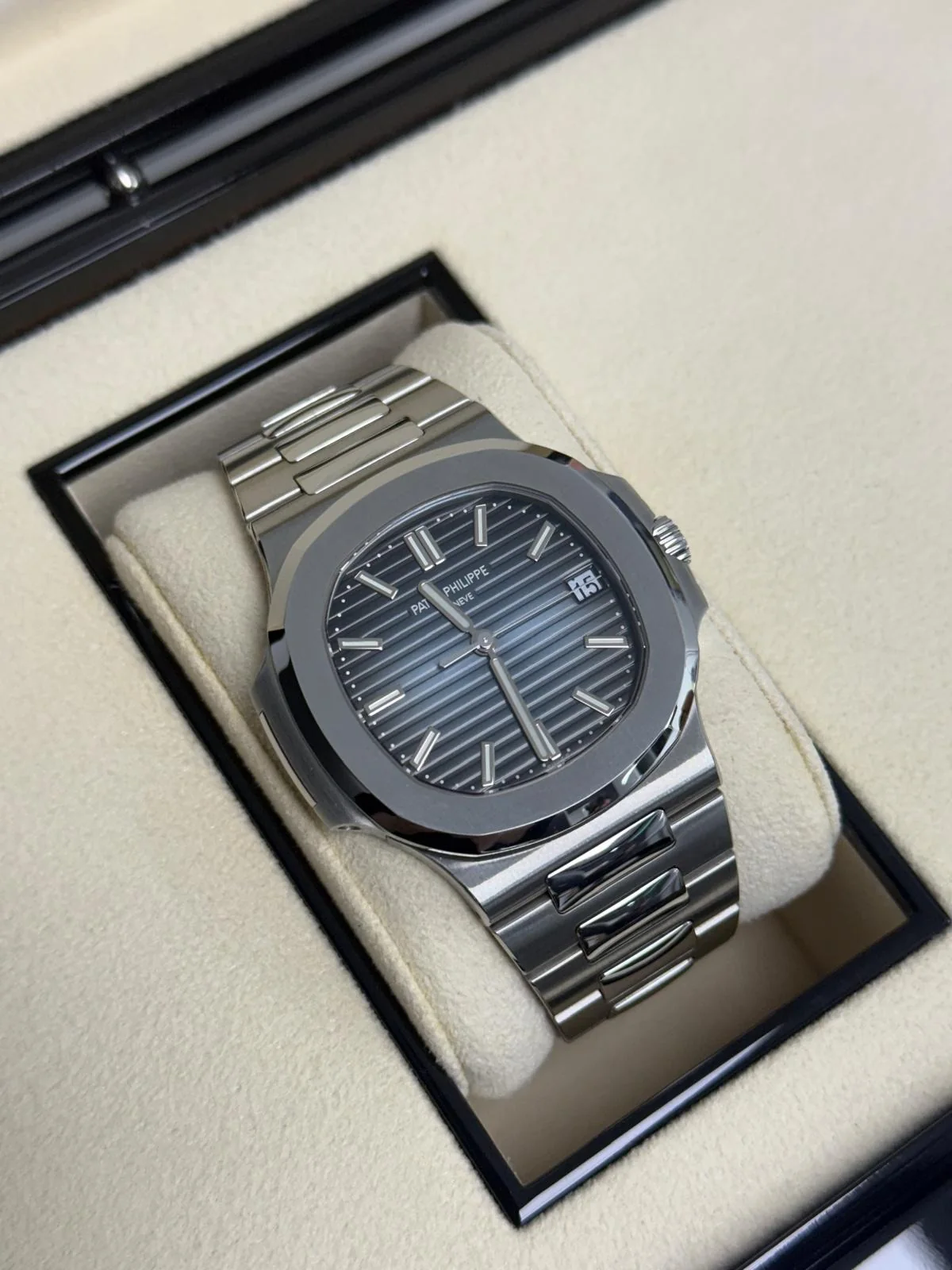
The short answer: the Nautilus is the watch where the reference and the paperwork do almost all of the talking, because a family that looks like one design across a room spans a 1970s monobloc "Jumbo", four decades of complications, and a steel reference whose production ended in a way that is still reported two different ways. Before you accept an offer, read the reference and the case number, work out which generation and calibre you hold, lay out the certificate of origin, inspect the case, bracelet and dial the way a buyer will, and verify that the buyer is a licensed second-hand dealer whose licence you can look up. On a Nautilus the buyer makes an offer from photographs, a call or messages first, and only authenticates the watch in person once you have accepted it.
Summary
The Nautilus is the Patek Philippe most often offered for sale in Australia, and the one owners most often describe imprecisely, because "steel Nautilus with a blue dial" covers watches separated by fifteen years, two calibres and two case diameters. It is organised the way a buyer works through one: reference and generation, then where your watch sits in the 5711 story, then the documents Patek Philippe issues and what each one actually is, then the physical checks that matter on an integrated-bracelet sports watch, then the buyer, payment and the law. It is written by a business that buys these watches, so it has an obvious interest in you selling yours to us, and that is disclosed here rather than buried. Every factual claim in it is checkable against the sources listed at the end regardless of who you sell to.
Key takeaways
- The reference, not the word "Nautilus", is what a buyer assesses, down to the dial digits after the hyphen.
- The original 3700/1 of 1976 is a different proposition from anything that followed: a 42 mm monobloc case with the movement fitted from the dial side, and production that stopped in 1990.
- The modern era begins with the 5711 in 2006. The sources disagree on how its end should be described, and this guide sets out what each one says.
- Two calibres dominate the time-and-date references: the 324 S C from 2006, and the 26-330 S C that replaced it in 2019 and still runs the 5811 and 7118.
- The certificate of origin is the document Patek Philippe treats as the warranty. An Extract from the Archives is a transcript of the archive record, not that document.
- Bracelet stretch, a polished case and a replaced dial move a Nautilus offer most, and all three are things you can check before you contact anyone.
Who this guide is for
Someone in Australia who owns a Patek Philippe Nautilus of any reference, is considering selling it, and wants to understand what a serious buyer will look at before that buyer does. It assumes you have the watch in hand and can photograph it. It does not give prices, because a figure quoted without the reference, the documents and an inspection is a guess dressed up as a fact.
How this guide was prepared
Reference numbers, production years, calibres, case dimensions, water resistance and power reserve figures were checked on 25 September 2026 against Patek Philippe's own pages where the reference is still in the collection, and otherwise against independent reference histories and the launch coverage of publications that handled the watches. The Nautilus history published by Monochrome Watches and the Nautilus guide published by Sotheby's were both read for this article, and where they say different things the text says so. Where a figure could not be confirmed against a source we read, it has been left out rather than hedged. The legal position is Victorian, because Buy Your Watch holds its licence in Victoria, and the statutory material is cited to the regulator that publishes it. Nothing here is legal, financial or tax advice.
The Patek Philippe Nautilus at a glance
The table below covers the references a buyer in Australia most often sees. Years are the introduction years given by the histories cited here; where two sources describe a change differently, the text says which said what. [1] [2] [3]
| Reference | From | Case | Calibre | What sets it apart |
|---|---|---|---|---|
| 3700/1 "Jumbo" | 1976 | 42 mm, 7.6 mm high, 120 m | 28-255 C | The original, designed by Gerald Genta. A patented monobloc case, a solid module into which the movement is inserted from the dial side. The calibre was sourced outside Patek Philippe, from the Jaeger-LeCoultre 920. Production stopped in 1990. [1] |
| 3800 | 1980 | 37.5 mm | Automatic | The mid-size Nautilus, and the reference that bridges vintage and modern collecting. [2] |
| 4700 | 1980s | 26 mm on the 4700/153 | Quartz | The ladies' Nautilus of the era. The 4700/153 is a white gold example with a factory diamond bezel and emerald hour markers. [2] |
| 5711/1A | 2006 | 40 mm steel, 43 mm across the ears, 120 m | 324 S C, later 26-330 S C | Introduced for the model's thirtieth anniversary and the reference most people mean by "Nautilus". Power reserve of 35 to 45 hours. [3] See the next section for what happened to it. |
| 5712 | 2006 | 40 mm, 60 m | 240 PS IRM C LU | The asymmetric dial: moon phase, power reserve indicator, date and small seconds, on a micro-rotor movement. [3] |
| 5726 | 2010 | 40.5 mm | 324 | Annual calendar with day, date, month and moon phase, and a 24-hour indication. [3] |
| 5980 | 2006 | 40.5 mm, 120 m | CH 28-520 C | The Nautilus chronograph, with a flyback function and a power reserve of 45 to 55 hours. [3] [2] |
| 5990 | 2014 | 40.5 mm | CH 28-520 C FUS | Described by Sotheby's as the first model to combine a flyback chronograph with a dual time display. [2] [3] |
| 5740/1G | 2018 | 40 mm white gold, 8.42 mm high, 60 m | 240 Q | The first time the Nautilus received a movement of this complexity: a perpetual calendar reading month and leap year at 3, moon and date at 6, day and a 24-hour indication at 9. Power reserve of 38 to 48 hours. [4] |
| 7118/1A | Current collection | 35.2 mm steel, 8.62 mm high, 30 m | 26-330 S C | The current ladies' Nautilus. Blue opaline wave-pattern dial, white gold applied markers, patented fold-over clasp with a lockable adjustment system, power reserve of 35 to 45 hours. [5] |
| 5811/1G | October 2022 | 41 mm white gold, 120 m | 26-330 S C | The reference that took over from the 5711. The case grew from 40 mm to 41 mm and returned to a two-part construction, with a patent-pending lever that lets the winding stem be pulled from the dial side. The clasp gained a micro-adjustment system extending by 2 to 4 mm. [6] |
Water resistance on the 3700/1, the 5711 and the 5811 is 120 metres, [1] [3] [6] while the complicated and ladies' references are rated lower, at 60 metres on the 5712 and the 5740 and 30 metres on the 7118. [3] [4] [5] Power reserve on the 324 S C and 26-330 S C families is quoted by Patek Philippe as a minimum of 35 hours and a maximum of 45. [5] [6] On accuracy, Patek Philippe applies its own standard rather than an external one: the Patek Philippe Seal, created in 2009 by Philippe and Thierry Stern, requires a deviation of no more than minus 1 to plus 2 seconds per 24 hours, applies to all of the company's mechanical timepieces regardless of complexity, and is assessed in stages from the uncased movement through to the fully assembled watch. [7]
Identify the exact reference before you ask anyone for a figure
A Nautilus reference is written as a number, then a slash and a bracelet or case code, then a metal letter and a dial suffix: 5711/1A-010 is the steel, integrated-bracelet 5711 with the blue-black dial, and 5711/1A-014 is the same watch with the olive green dial. The letter gives the metal, A for steel, R for rose gold, G for white gold, J for yellow gold, P for platinum, and the digits after the hyphen identify the dial. Those last three digits are frequently the difference between two watches that photograph identically.
Your certificate of origin carries the reference, the movement number and the case number. Write the full reference down exactly, including the suffix, and use it in every message you send a buyer. "Steel Nautilus" invites a range; "5711/1A-010 with the certificate of origin dated March 2017" invites a figure.
Work out where your Nautilus sits in the 5711 story
This is the single most useful thing a Nautilus owner can establish, and it is also the point on which published accounts differ, so here is what each source actually says.
The 5711/1A arrived in 2006 for the model's thirtieth anniversary, running the calibre 324 S C. [3] That movement was replaced by the 26-330 S C in 2019, and every later 5711 carries it. [6] So a 5711 sold before 2019 and one sold after it are not mechanically the same watch, and a buyer will ask which you have.
On the end of the reference, the accounts read as follows. Revolution, reporting from Watches and Wonders in April 2021, wrote of "the announcement that 2021 will be the last production year of the stainless steel model Ref. 5711/1A", and presented the olive green 5711/1A-014, a 40 mm steel watch with the calibre 26-330 S C and 120 metres of water resistance, as the end of the series. [8] Sotheby's guide puts it as a discontinuation in 2021, writing that "following its discontinuation in 2021, the 5711 quickly became one of the most recognizable and sought-after watches in contemporary collecting". [2] aBlogtoWatch, writing about the same green-dialled watch, records that it "made its debut in spring 2021" and "disappeared from the lineup in January 2022", and calls it "the swan song of the entire reference". [9]
Between those dates came one more steel 5711. Swisswatches Magazine reported on 6 December 2021 the 5711/1A-018, a run of 170 pieces made with Tiffany and Co., in steel at 40 mm, with the calibre 26-330 S C, 12 bar of water resistance and a 45-hour power reserve, its dial carrying the Tiffany and Co. signature at six o'clock. [10] In October 2022 the 5811/1G-001 took the reference's place in white gold at 41 mm. [6]
The practical point for a seller is simple. Say which sub-reference and dial you hold, say which calibre is inside if you know, and let the buyer assess it rather than building a figure out of a headline about a discontinuation.
Establish what you actually have: the watch, the certificate, or the full set
Lay out everything that came with the watch and describe it exactly. Five things carry weight, in roughly this order.
- The certificate of origin. Patek Philippe describes it as being like a birth certificate delivered with every single new watch, giving the movement, case and reference numbers that identify a timepiece unequivocally, and says it serves as a warranty and must be held in safekeeping because no copy can ever be provided. [11] That last point is why its absence is felt: it cannot be reissued.
- Service records. On an older reference the record tells a buyer what has been replaced.
- The original invoice. Establishes provenance and is the document to keep if a tax question arises.
- Spare links. Sizing an integrated bracelet removes links, and those links are specific to the reference. Buyers notice when they are missing.
- The box and the outer packaging. Nice to have, least weighted of the five.
Plenty of Nautilus watches are offered to us as the watch alone, and that is a normal sale. Describe a watch-only Nautilus as watch only. The offer you are given on an accurate description is the offer you are paid.
Understand what an Extract from the Archives is, and what it is not
Owners of older references often ask whether an Extract from the Archives replaces a missing certificate. It does not, and the distinction is worth getting right. Patek Philippe describes an Extract as "a partial transcript regarding a particular timepiece from our Archives, as meticulously recorded since 1839". [11] It is available only where the watch's date of first sale exceeds ten years from the date of the request, and only one Extract can be requested per twelve-month period for the same timepiece; a service fee applies and is refunded if the watch turns out to be ineligible. [11]
So an Extract is a record of what the archive holds about the watch, obtained from the manufacturer, while the certificate of origin is the document Patek Philippe says serves as the warranty. [11] A buyer values an Extract on a 3700 or a 3800 because it confirms the reference, the case and movement numbers and the date of sale against the watch in front of them. It does not turn a watch-only sale into a full set. If you are selling a reference old enough to qualify, ordering one before you sell is often worth the time, because it answers questions the buyer would otherwise price for.
Understand why two Nautilus watches of the same reference draw different offers
Once the reference is settled, the differences that remain are physical, and they are all things you can inspect yourself.
The case, its edges and the back
The Nautilus case is shallow and its surfaces alternate between brushed tops and polished flanks, so polishing shows badly. On an original case the transition between the brushed bezel and the polished chamfer is a crisp line, the octagonal corners are defined, and the ears at three and nine o'clock still have square edges. A refinished case loses that line first. The 3700 is the extreme version of the problem, because its monobloc construction means the case is the watch and there is no separate back to take the wear. [1] Read the case number and any engraving on the back and match them to the certificate of origin. Presentation engraving added by a previous owner is a permanent alteration, so photograph it rather than describing it, and never have it removed, because removal means metal comes off the case.
The bracelet and stretch
The integrated bracelet is the part of a Nautilus that ages first. Hold the watch horizontally by the case with the bracelet hanging and look along the links: gaps opening between them, and a bracelet that droops rather than holding its curve, are the signs of stretch, which comes from wear in the link pins over years of use. Stretch cannot be reversed by cleaning, and it is one of the most common reasons a seller's expectation and a buyer's offer sit apart. Note also that the 5811 introduced a micro-adjustment system in the clasp that earlier references do not have, so a clasp with that feature belongs on a 5811 and not on a 5711. [6]
The dial, the crown and the crystal
The horizontally embossed dial is the signature of the design, and it is also what a replaced dial gets wrong. Look at the grooves across the whole surface under angled light: the pitch should be even from edge to edge, the printing should sit square in its groove, and the applied markers should be seated flat with no lifting at the ends. Luminous plots that have aged to different colours suggest a replacement, and a dial colour that was never offered on your reference is the clearest sign of all. The crown should screw down positively where the reference has one, the watch should set cleanly through its positions, and the crystal should be free of chips along its edge.
Check the watch the way a buyer will
- Read the reference and the case number and match both to the certificate of origin, including the dial suffix after the hyphen.
- Wind and set it. The watch should wind smoothly, set cleanly, and on a screw-down crown seal without crossing the thread. Let it run for a day and note whether it keeps reasonable time.
- Check the date change, and on a 5712, 5726 or 5740 check that the moon phase and calendar indications are correctly set and advancing.
- Test the bracelet for stretch by holding the case and letting the bracelet hang, then looking along the links for gaps, and check the clasp closes positively with no play in the fold-over mechanism.
- Inspect the case edges under angled light for the crispness of the brushed-to-polished transitions and the octagonal corners.
- Inspect the dial under a loupe for even embossing, seated markers and square printing.
- Photograph everything in daylight: dial straight on, case sides, the ears from above, the case back, the crown, the clasp open and closed, the bracelet hanging, the spare links, and every document. Send the case and movement numbers to your chosen buyer only.
Our guide to what the condition grades a buyer uses actually mean sets out how these findings become a grade.
Verify the buyer, not just the offer
- Licence number, looked up. Second-hand dealing is licensed state by state; in Victoria under the Second-Hand Dealers and Pawnbrokers Act 1989. Buy Your Watch's number is SHD-0017882, issued by Consumer Affairs Victoria.
- ABN on ABN Lookup, matching the licence name and the account the money comes from. Ours is 85 670 502 315.
- Who authenticates, and when. Buy Your Watch uses certified watchmakers in every Australian capital city; they are partner businesses, not our own premises, and that is stated plainly rather than implied. The offer is made before they see the watch, not by them.
- A written offer, made on your photographs and description, conditional on authentication, with a timeframe attached.
- Reviews with the dates showing. Ours is 4.9 from 64 Google reviews.
Our guide to where to sell a Patek Philippe in Australia applies the same checks across the routes open to you.
Want a written offer on your Nautilus? Send the full reference, a few photographs and a note of what documents you hold. We assess the watch from what you send and reply with a written figure conditional on authentication; a certified watchmaker sees the watch in person only after you accept, and the whole process takes 24 to 48 hours from submission to payment.
Know what a licensed dealer must record, and what payment should look like
Sellers are sometimes surprised to be asked for photo identification by the business buying their watch. In Victoria the dealer has no choice. Consumer Affairs Victoria states that second-hand dealers and endorsed pawnbrokers must request proof of identity from everyone attempting to sell or pawn goods, and "must refuse to accept the goods if the person is unable to produce it, unless an exemption applies to the second-hand dealer or the goods". One form of photo identification is required, such as a passport or a driver's licence, or two forms without a photograph; the requirement sits under the Second-Hand Dealers and Pawnbrokers Act 1989 and regulation 12 of the regulations made under it. [12]
The dealer must then write the transaction down. Consumer Affairs Victoria sets out that the record must include "an accurate description of the goods, including a description of any identifying mark or label", the identifying mark or number the dealer assigns to the goods, the seller's full name and address, details of the identification the seller provided, the date and time the goods were received, the price paid, and the name of any employee or person acting on the dealer's behalf. [13] On a Nautilus that means the case number is written down. A buyer who does not ask for your licence or passport is either not licensed or not following the law they are licensed under, and neither is the buyer for a watch worth this much.
Payment from a licensed dealer is a bank transfer to an account in your name, made after authentication. Once authenticated by our certified watchmakers, payment is sent by Osko bank transfer, which typically lands in minutes once sent. The entire process takes 24 to 48 hours from submission to payment. Treat any departure from that sequence as a warning: gift cards, cryptocurrency, a cheque drawn on an overseas account, or a courier who will bring the cash are not how a licensed Australian dealer pays for a watch, and no legitimate buyer asks you to pay anything up front for insurance, authentication or a release fee.
The tax question, briefly
Whether selling a Nautilus has a tax consequence depends on whether you made a gain and on which category of asset the Australian Taxation Office puts the watch in. Many used watches sell for less than they cost, in which case there is no gain to tax. Where there is a gain, the category decides what applies, and anyone quoting you a confident threshold without knowing your circumstances is guessing. We set out the categories and the record-keeping rule in our guide to the paperwork, the law and the tax question. Keep the original invoice and the record of the sale for at least five years, and for advice you can rely on, use a registered tax agent.
Compare offers like with like
Three offers on the same Nautilus are only comparable if all three were made on the same information and on the same terms. Before you compare the figures, check that each buyer:
- quoted on the same full reference including the dial suffix, with the same description of the documents and the condition;
- put the offer in writing, conditional on the same authentication step, and made it before inspecting rather than after taking the watch;
- pays by bank transfer, not by cheque, store credit or a consignment arrangement where you are paid only if the watch sells on;
- covers postage and insurance, or tells you plainly that you do;
- gave a timeframe, because an offer with no date attached can be withdrawn the day the market moves.
Auction and consignment deserve a mention on this model, because the Nautilus is the Patek Philippe most often put to an auction house. Either can produce a strong result, but you carry the risk: the watch leaves your possession, you are paid only on sale, and the fee comes off the top. Compare an estimate against a firm purchase offer only after subtracting the fee and discounting for the chance the watch does not sell inside the time you have. Our guide to where to sell a watch in Australia sets the routes side by side.
Common mistakes that cost Nautilus sellers money
- Describing the watch without the dial suffix. The digits after the hyphen separate watches that photograph identically.
- Not knowing which calibre is inside. The 324 S C and the 26-330 S C both run the 5711, and the changeover was in 2019. Getting it wrong in your first message costs you credibility with the buyer.
- Treating an Extract from the Archives as a replacement certificate. It is a transcript of the archive record, not the document Patek Philippe issues as the warranty.
- Polishing the case before selling. It removes metal, softens the octagonal corners and the brushed-to-polished line, and tells the buyer the watch has been prepared. Clean it with a soft cloth and warm water, nothing more.
- Hiding bracelet stretch. It is found in the first minute of an inspection by the same test you can run at home. Disclose it and the offer accounts for it; hide it and the offer is withdrawn.
- Fitting a clasp or links from another reference, which is a deduction even when the part is genuine Patek Philippe.
- Accepting a verbal offer, or one with no condition and no timeframe stated.
If you would rather keep the watch
Selling is not the only way to release the value in a Nautilus. A pawn loan lets you borrow against the watch for a fixed term and take it back when the loan is repaid, with the watch held as the security. Buy Your Watch offers this under the same Victorian licence, with a minimum advance of $15,000 over terms of 3 to 12 months, a $400 setup fee, interest of 4% to 10% per month depending on assessment, and a maximum annual percentage rate of 131%. Our guide to selling your watch or borrowing against it sets the options side by side, how pawning a watch works in Australia walks through the process, and what happens if you cannot repay a watch loan covers the position on default.
What Buy Your Watch buys, and how it works
Founded in Melbourne in 2023, Buy Your Watch Pty Ltd has purchased more than 1,000 watches, holds second-hand dealer and pawnbroker licence SHD-0017882, and buys from every state. We buy Rolex, Patek Philippe, Audemars Piguet, Richard Mille, Cartier, Vacheron Constantin and F.P. Journe, in any Nautilus reference from the 3700 to the current 5811 and 7118. Send the full reference and photographs and you will have a free valuation within 24 hours, made on what you send rather than after we have the watch. Our comparison of Patek Philippe and Audemars Piguet covers how the two families are assessed.
Pre-sale checklist
- Full reference written down exactly, including the metal letter and the dial suffix after the hyphen
- Case number read from the case and matched to the certificate of origin
- Calibre identified as the 324 S C or the 26-330 S C where the reference carries one of them
- Documents laid out and described exactly: certificate of origin, service records, invoice, spare links, box
- Extract from the Archives ordered if the watch qualifies and the certificate is missing
- Watch wound, set and run for a day, the date change checked, and the calendar and moon phase checked on a 5712, 5726 or 5740
- Bracelet hung from the case and checked along the links for stretch, and the clasp checked for play
- Case edges checked under angled light for polishing, and the case back checked for added engraving
- Dial checked under a loupe for even embossing, seated markers and square printing
- Photographs taken in daylight of every angle, the spare links and every document
- Buyer's licence number looked up on the state register, and the ABN matched to the paying account
- Written offer received on your photographs, conditional on authentication, with a timeframe
- Payment method confirmed as bank transfer to an account in your name
- Watch sent insured for full value, signature on delivery, case number photographed in the packaging
This is general information, not legal, financial or tax advice. Where it states a legal position it names the Act and the regulations it comes from, checked against the regulator's published guidance on 25 September 2026. Reference data, calibres, dimensions and production years were checked against the sources listed below on the same date, and figures that could not be confirmed have been left out.
Frequently Asked Questions
How do I identify which Patek Philippe Nautilus I have?
Read the full reference, not just the model number. A Nautilus reference is a number, then a slash and a bracelet or case code, then a metal letter and a dial suffix, so 5711/1A-010 is the steel 5711 with the blue-black dial and 5711/1A-014 is the same watch with the olive green dial. The letter gives the metal: A for steel, R for rose gold, G for white gold, J for yellow gold, P for platinum. The certificate of origin carries the reference with the movement and case numbers, and the case number is engraved on the watch.
When was the Patek Philippe Nautilus 5711 discontinued?
Published accounts describe it in two ways and this guide sets out both. Revolution, reporting from Watches and Wonders in April 2021, referred to the announcement that 2021 would be the last production year of the steel 5711/1A and presented the olive green 5711/1A-014 as the end of the series. Sotheby's guide calls it a discontinuation in 2021. aBlogtoWatch records that the green dial made its debut in spring 2021 and disappeared from the lineup in January 2022. A 170-piece 5711/1A-018 made with Tiffany and Co. was reported on 6 December 2021.
What replaced the Nautilus 5711?
The 5811/1G-001, introduced in October 2022 in white gold. The case grew from 40 mm to 41 mm and returned to a two-part construction, with a patent-pending lever that lets the winding stem be pulled out from the dial side, and the clasp gained a micro-adjustment system that extends by 2 to 4 mm. It keeps 120 metres of water resistance and the calibre 26-330 S C, with a power reserve of 35 to 45 hours.
What is the difference between the calibre 324 S C and the calibre 26-330 S C?
The 324 S C ran the 5711 from its introduction in 2006. The 26-330 S C replaced it in 2019, and it is the movement in the later 5711 references, in the 5811 that followed and in the current ladies' 7118. Both are self-winding with a centre seconds hand and a date, and Patek Philippe quotes a power reserve of a minimum of 35 hours and a maximum of 45. A 5711 sold before 2019 and one sold afterwards are not mechanically the same watch, so a buyer will ask which you hold.
Is an Extract from the Archives the same as a certificate of origin?
No. Patek Philippe describes the certificate of origin as being like a birth certificate delivered with every new watch, giving the movement, case and reference numbers, and says it serves as a warranty and must be kept because no copy can ever be provided. An Extract from the Archives is described as a partial transcript regarding a particular timepiece from the archives, recorded since 1839. It can be requested only where the date of first sale exceeds ten years from the request, and only once per twelve-month period per watch. A buyer values an Extract on an older reference, but it does not turn a watch-only sale into a full set.
What is bracelet stretch, and does it change the offer on a Nautilus?
It is wear in the pins that join the bracelet links, and it accumulates over years of wear. Test it by holding the case horizontally and letting the bracelet hang: gaps opening between the links, or a bracelet that droops rather than holding its curve, are the signs. The integrated bracelet is the part of a Nautilus that ages first, stretch cannot be reversed by cleaning, and it is assessed on every used example, so it does affect the offer. Disclose it and the offer accounts for it.
Does a Nautilus without box and papers still sell?
Yes. A watch-only Nautilus is a normal sale. The certificate of origin matters most, because Patek Philippe treats it as the warranty document and says no copy can ever be provided, which is why its absence is felt. The box matters least. Describe exactly what you hold rather than optimistically, and the offer you receive on that description is the offer you are paid.
Should I polish or service my Nautilus before selling it?
Do not polish it. The Nautilus case alternates brushed tops with polished flanks, and refinishing softens the octagonal corners and the crisp line between the two finishes, which buyers read as a watch that has been prepared. A service is a different question: on an older reference a buyer will price the work in either way, so there is rarely an advantage in paying for it yourself first. Clean the watch with a soft cloth and warm water and sell it as it is.
Does Buy Your Watch buy the Patek Philippe Nautilus?
Yes, in any reference from the 3700 through the 5711, 5712, 5726, 5980, 5990 and 5740 to the current 5811 and 7118, in steel, gold and platinum. Send the full reference including the dial suffix, along with photographs and a note of the documents you hold, and you will have a free valuation within 24 hours, made on what you send rather than after we have the watch.
How is payment made when you sell a Nautilus to a dealer?
By bank transfer to an account in your name after the watch has been authenticated. Buy Your Watch makes its offer first, from your photographs, a call or messages; a certified watchmaker inspects the watch in person only after you accept. Once authenticated, payment is sent by Osko bank transfer, which typically lands in minutes once sent, and the entire process takes 24 to 48 hours from submission to payment. Expect to be asked for photo identification: Consumer Affairs Victoria requires a licensed dealer to request proof of identity and to refuse the goods if it is not produced.
Sources and references
- History of the Patek Philippe Nautilus, Part 1: the birth of an icon, the 3700 (1976/1990), Monochrome Watches
- The complete guide to the Patek Philippe Nautilus, Sotheby's
- History of the Patek Philippe Nautilus, Part 3: the modern days (2006/present), Monochrome Watches
- Patek Philippe Nautilus Perpetual Calendar 5740G, Baselworld 2018, Monochrome Watches
- Ladies' Nautilus blue dial stainless steel, ref. 7118/1A-001, Patek Philippe
- Introducing the new Patek Philippe Nautilus 5811/1G, which replaces the 5711, Monochrome Watches
- The Patek Philippe Seal, a symbol of excellence, Patek Philippe
- Patek Philippe announces the end of series 5711 with olive green dial, Revolution
- Hands on: Patek Philippe Nautilus 5711 green dial watch, aBlogtoWatch
- New Nautilus with Tiffany dial: Patek Philippe Nautilus 5711/1A-018, Swisswatches Magazine
- Extract from the Archives, frequently asked questions, Patek Philippe
- Evidence of identity: second-hand dealer and pawnbroker obligations, Consumer Affairs Victoria
- Keeping records: second-hand dealer and pawnbroker obligations, Consumer Affairs Victoria